

Skip to content

Intelligence Layer

One account, one ledger, one agent layer. The modules are what you switch on.

Platform overview
The AI Intelligence Layer

One intelligence layer under every module: the same data, the same agents, the same ledger, whichever function you switch on.

  • One layer, every module
  • Shared data and agents
  • Every run on one ledger
Go to The AI Intelligence Layer
Isometric stack of pale grey slabs wired together on white, with one layer filled deep cyanStart hereThe architecture is the argumentWhy adding the sixth module costs a fraction of buying the first.Read the architecture
The Architecture

One account carries every brand you run. Modules are switched on per brand, and every run lands in the same ledger.

  • One account, many brands
  • Modules toggle per brand
  • A single billing ledger
Go to The Architecture
Isometric stack of pale grey slabs wired together on white, with one layer filled deep cyanStart hereThe architecture is the argumentWhy adding the sixth module costs a fraction of buying the first.Read the architecture
The agent layer

Three kinds of agent. Watchers notice, drafters produce, and Ask Intelligence answers from your own numbers.

  • Watchers run on a schedule
  • Drafters wait for sign-off
  • Answers carry their source
Go to The agent layer
Isometric stack of pale grey slabs wired together on white, with one layer filled deep cyanStart hereThe architecture is the argumentWhy adding the sixth module costs a fraction of buying the first.Read the architecture
Security

Isolated tenancy, roles that mean something, and a plain answer about what leaves your account.

  • Per-tenant isolation
  • Roles down to the module
  • Stated data boundaries
Go to Security
Isometric stack of pale grey slabs wired together on white, with one layer filled deep cyanStart hereThe architecture is the argumentWhy adding the sixth module costs a fraction of buying the first.Read the architecture

Seats are free — you pay for what the AI runs

Book a demoOpen your account

Capabilities

The AI you work with directly, and the modules it already runs. Take one, or take them all.

See all modules

AI Assistance

Work with the AI directly

Ask Intelligence

Ask a business question in plain words. It reads your own data through read-only tools scoped to the brand, and answers with the real figure or says the data is not there.

  • Fifteen read-only tools
  • Scope enforced in code
  • Never invents a number
Go to Ask Intelligence
Playground

A direct chat with the models your administrator allows. No brand data: the model sees the conversation, your files and your instructions.

  • Compare three models side by side
  • Files in, documents out
  • The price under every answer
Go to Playground
Agents

Three kinds of agent do the standing work: watchers notice, drafters produce, and nothing ships until someone with the role signs.

  • Watchers run on a schedule
  • Drafters wait for sign-off
  • Every run lands on the ledger
Go to Agents
Skills

How a brief is built, how a campaign is structured, what a decent article looks like — the craft of the people who built this, shipped as the default setting.

  • Senior practice built in
  • Defaults you adjust
  • Nothing to write from scratch
Go to Skills

Modules & Features

The functions it runs

Business Intelligence

Ask your business a question in plain words and get the real number back, with the source that produced it.

  • Plain-language questions
  • Every figure sourced
  • Board-ready reporting
Go to Business Intelligence
Project Management

The board where an insight becomes a card with an owner, instead of a dead report nobody actions.

  • Kanban with a timeline
  • One click, insight to task
  • Owner and date attached
Go to Project Management
Sales

Pipeline that drafts its own paperwork, and flags the deals that went quiet before you notice.

  • Quotes off the deal record
  • Quiet deals surfaced
  • Revenue projected forward
Go to Sales
Brand Marketing

The content engine and the Creative Studio behind the brand: articles buyers actually search for, and the images and video that carry them.

  • Eight-stage content engine
  • Creative Studio built in
  • Drafts wait for sign-off
Go to Brand Marketing
Social

Posts drafted from work you have already approved — an article becomes the thread, a launch becomes the post — on a calendar you sign.

  • Drafts from approved work
  • A calendar you sign
  • One voice on every network
Go to Social
Search

Watches where you rank, ties every position to the page that earned it, and says what to write next — with GEO watching the AI assistants.

  • Rank tracked continuously
  • Positions tied to pages
  • GEO polls the assistants
Go to Search
Ads

Search campaigns arrive built — ad groups, keywords, copy — priced before they run, and paused the moment they stop earning.

  • Campaigns priced first
  • Ad groups arrive built
  • Paused when they slip
Go to Ads
Customer Service

Answers from what you gave it, on your own page, and it says so plainly when it does not know.

  • Grounded in your content
  • Refuses to invent
  • Escalates to a human
Go to Customer Service
IT Support

The support desk turned inward: employees ask, it answers from your own systems and documentation, and escalates what it cannot resolve.

  • Answers from your docs
  • Tickets triaged first
  • Escalates to a human
Go to IT Support

Seats are free — you pay for what the AI runs

Book a demoOpen your account

Services

The people around the product, from the first connection to a named operator on your account.

All services
Onboarding

A guided session to connect your data and switch on the first function, then a first week planned day by day.

  • One guided session
  • First function live in a week
  • A person on the other end
Go to Onboarding
A fanned stack of white ruled sheets with the top one edged in deep cyanLarger organizationsRoll out by brand, by team, by functionOne account, one ledger, roles down to the function. Staged so procurement never has to open a file.See the group rollout
Data integration

We connect the systems you already run and prepare the data behind them, so every answer has a source.

  • Connectors built and tested
  • Metrics defined once
  • Sources reconciled
Go to Data integration
A fanned stack of white ruled sheets with the top one edged in deep cyanLarger organizationsRoll out by brand, by team, by functionOne account, one ledger, roles down to the function. Staged so procurement never has to open a file.See the group rollout
Intelligence audit

A fixed-price review of where you rank, what the AI assistants answer, and which function pays back first.

  • Four assistants polled
  • Search position by market
  • A ranked starting point
Go to Intelligence audit
A fanned stack of white ruled sheets with the top one edged in deep cyanLarger organizationsRoll out by brand, by team, by functionOne account, one ledger, roles down to the function. Staged so procurement never has to open a file.See the group rollout
Training

Sessions for the people who will approve, review and ask, so the workforce is used rather than watched.

  • By role, not by feature
  • Live on your account
  • Recorded for the next hire
Go to Training
A fanned stack of white ruled sheets with the top one edged in deep cyanLarger organizationsRoll out by brand, by team, by functionOne account, one ledger, roles down to the function. Staged so procurement never has to open a file.See the group rollout
Managed operations

Someone reviews what the watchers found, approves the drafts within your caps, and runs the weekly review.

  • Drafts approved in your name
  • Caps respected
  • Weekly review delivered
Go to Managed operations
A fanned stack of white ruled sheets with the top one edged in deep cyanLarger organizationsRoll out by brand, by team, by functionOne account, one ledger, roles down to the function. Staged so procurement never has to open a file.See the group rollout
Custom features

An agent or a function built for your process, on the same ledger and under the same approval gates.

  • Scoped before it is priced
  • Same gates, same ledger
  • Yours to keep
Go to Custom features
A fanned stack of white ruled sheets with the top one edged in deep cyanLarger organizationsRoll out by brand, by team, by functionOne account, one ledger, roles down to the function. Staged so procurement never has to open a file.See the group rollout
Dedicated hosting

A single-tenant deployment in the region you choose, with the data boundary written down and an uptime commitment.

  • Single tenant
  • Region of your choice
  • Uptime in writing
Go to Dedicated hosting
A fanned stack of white ruled sheets with the top one edged in deep cyanLarger organizationsRoll out by brand, by team, by functionOne account, one ledger, roles down to the function. Staged so procurement never has to open a file.See the group rollout
Premium Support

A named contact, committed response times, and a quarterly review of what ran, what it cost and what to change.

  • Named contact
  • Committed response times
  • Quarterly review
Go to Premium Support
A fanned stack of white ruled sheets with the top one edged in deep cyanLarger organizationsRoll out by brand, by team, by functionOne account, one ledger, roles down to the function. Staged so procurement never has to open a file.See the group rollout

Seats are free — you pay for what the AI runs

Book a demoOpen your account

About

Why this was built, who is behind it, what it has done for the companies running it, and how to run it well.

About BearingBridge
Why we built it?

What a company can do has been capped by who it could afford to hire. That cap is the thing that moved.

  • Capability, not headcount
  • Written, not benchmarked
  • No lock-in claim
Go to Why we built it?
A row of pale grey blocks climbing steeply to a single tall deep cyan block, a hairline curve tracing the riseThe short versionPunch above your headcountThe AI workforce for companies that need more capability than they can staff.Read the argument
Who is behind BearingBridge?

Who built this, what it is independent of, and why that independence is worth stating out loud.

  • Model-independent
  • No data resale
  • Named people behind it
Go to Who is behind BearingBridge?
A row of pale grey blocks climbing steeply to a single tall deep cyan block, a hairline curve tracing the riseThe short versionPunch above your headcountThe AI workforce for companies that need more capability than they can staff.Read the argument
How we run the work

The six-phase method every account is built on: a written bearing, a dated baseline, a pilot on real data, and a fix that reconciles the money.

  • A kill criterion, in writing
  • Costs watched as they run
  • An ending without us
Go to How we run the work
A row of pale grey blocks climbing steeply to a single tall deep cyan block, a hairline curve tracing the riseThe short versionPunch above your headcountThe AI workforce for companies that need more capability than they can staff.Read the argument
Case studies

Ten builds told the way they ran: the situation, what was built, what changed months later, and what got switched off.

  • Sector and function stated
  • Client-verified figures
  • The stopped work left in
Go to Case studies
A row of pale grey blocks climbing steeply to a single tall deep cyan block, a hairline curve tracing the riseThe short versionPunch above your headcountThe AI workforce for companies that need more capability than they can staff.Read the argument
FAQ

The questions that come up before every demo, answered here so the demo can be about your business.

  • Product and billing
  • Security and data
  • Answered in plain words
Go to FAQ
A row of pale grey blocks climbing steeply to a single tall deep cyan block, a hairline curve tracing the riseThe short versionPunch above your headcountThe AI workforce for companies that need more capability than they can staff.Read the argument
Testimonials

Customers on the module they actually run, quoted directly, with the module named.

  • Module named each time
  • Quoted, not paraphrased
  • Role and size given
Go to Testimonials
A row of pale grey blocks climbing steeply to a single tall deep cyan block, a hairline curve tracing the riseThe short versionPunch above your headcountThe AI workforce for companies that need more capability than they can staff.Read the argument
Changelog

What shipped, dated, newest first. The place to check whether the thing you were promised exists yet.

  • Dated entries
  • Shipped only
  • Linked to the module
Go to Changelog
A row of pale grey blocks climbing steeply to a single tall deep cyan block, a hairline curve tracing the riseThe short versionPunch above your headcountThe AI workforce for companies that need more capability than they can staff.Read the argument
Partner program

Run the platform for the companies you advise. Every client is a brand on your account, billed on its own ledger.

  • Clients as brands
  • Separate ledgers
  • Margin on every run
Go to Partner program
A row of pale grey blocks climbing steeply to a single tall deep cyan block, a hairline curve tracing the riseThe short versionPunch above your headcountThe AI workforce for companies that need more capability than they can staff.Read the argument

Seats are free — you pay for what the AI runs

Book a demoOpen your account

Pricing

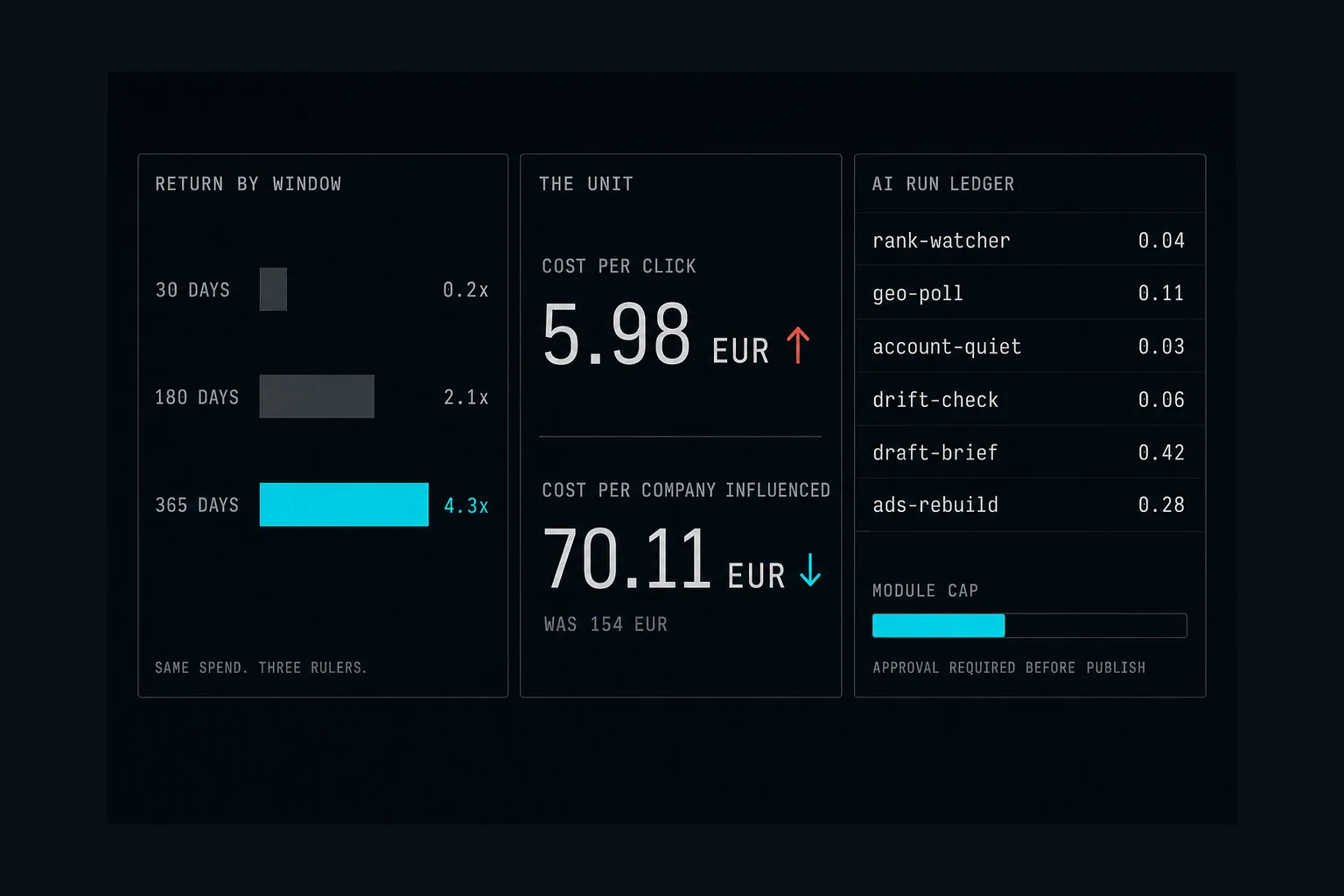
Seats are free. You pay for what the AI actually runs, and you see the price first.

Full pricing
How it works

Three sentences, and that is the whole model. No tiers to decode, no per-seat arithmetic to do.

  • No seat licence
  • No annual lock-in
  • Three sentences long
Go to How it works
Ten pale meter tracks filled to different levels in deep cyan, cut by one horizontal cyan limit lineNo surprisesYou see the price before you run itThe price, the caps and the gates, all visible before anything spends.Open pricing
Seats

Give an account to everyone who needs one. The number on the invoice does not move when you do.

  • Unlimited accounts
  • Zero per-seat cost
  • Roles still enforced
Go to Seats
Ten pale meter tracks filled to different levels in deep cyan, cut by one horizontal cyan limit lineNo surprisesYou see the price before you run itThe price, the caps and the gates, all visible before anything spends.Open pricing
What things cost

Every run is priced from your wallet before or as it runs, and the machine’s own mistakes are not billed to you.

  • Quoted before it runs
  • Retries are on us
  • Itemised in the ledger
Go to What things cost
Ten pale meter tracks filled to different levels in deep cyan, cut by one horizontal cyan limit lineNo surprisesYou see the price before you run itThe price, the caps and the gates, all visible before anything spends.Open pricing
Caps and gates

A hard cap per module, and an approval gate in front of anything that publishes or spends.

  • Hard cap per module
  • Approval before publish
  • A zero balance stops the AI
Go to Caps and gates
Ten pale meter tracks filled to different levels in deep cyan, cut by one horizontal cyan limit lineNo surprisesYou see the price before you run itThe price, the caps and the gates, all visible before anything spends.Open pricing
Questions

The questions people actually ask about the bill, answered on the page rather than in a call.

  • Overage answered
  • Cancellation answered
  • Migration answered
Go to Questions
Ten pale meter tracks filled to different levels in deep cyan, cut by one horizontal cyan limit lineNo surprisesYou see the price before you run itThe price, the caps and the gates, all visible before anything spends.Open pricing

Seats are free — you pay for what the AI runs

Book a demoOpen your account

Insights

Three collections, one standard: long-form, sourced, dated, and never behind a form.

All insights
AI Trends

What is moving under the industry: model economics, the Chinese price tier, and how buyers now ask assistants instead of searching.

  • The model market, read closely
  • AI search and citations
  • Every claim sourced and dated
Go to AI Trends
A fanned stack of white ruled sheets with the top one edged in deep cyanThe standardLong-form, sourced, never gatedEach piece answers the question in its title completely, carries its date, and sits behind no form.Open the library
Best Practices — AI Guide

The working guide: when to buy and when to build, when an agent is the wrong tool, and what survives contact with production.

  • Build-or-buy, decided
  • Architectures that ship
  • Prompts that do real work
Go to Best Practices — AI Guide
A fanned stack of white ruled sheets with the top one edged in deep cyanThe standardLong-form, sourced, never gatedEach piece answers the question in its title completely, carries its date, and sits behind no form.Open the library
CEO's Opinion

Signed columns from the person running the company: what building agents across six functions actually shows, ahead of the industry line.

  • Signed, never ghostwritten
  • From live builds, not decks
  • Positions, not press releases
Go to CEO's Opinion
A fanned stack of white ruled sheets with the top one edged in deep cyanThe standardLong-form, sourced, never gatedEach piece answers the question in its title completely, carries its date, and sits behind no form.Open the library

Seats are free — you pay for what the AI runs

Book a demoOpen your account

Insights/Best Practices — AI Guide/Data foundations

You can buy the platform. Not the context.

Most companies should buy the agent platform rather than build one. What they cannot buy is the thing that decides whether it works, which is sitting in their own systems right now.

39

points of self-assessment error, METR trial

42%

of companies abandoning most AI initiatives

0

items procurement moves from yours to theirs

BearingBridgeJuly 20268 min read

Two engineers wire a modular equipment rack in an integration workshop, one kneeling to route a bundle of cables while the other slots a prebuilt module into place, beside a cart stacked with identical modules in padded cases
On this sheet

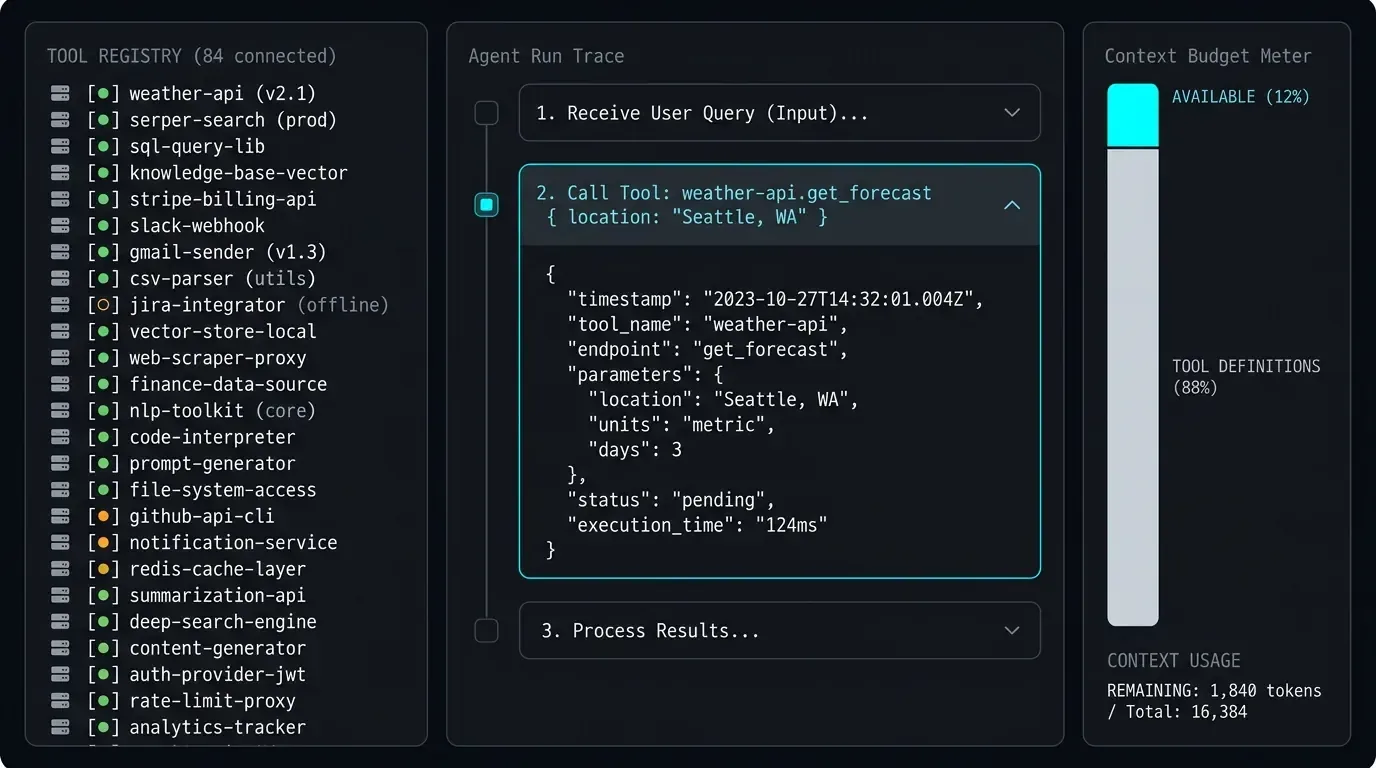
Something changed in how AI work is sold this year. The unit is no longer a bespoke build. It is an assembled platform: an agent runtime, a governance layer, a marketplace of prebuilt components, and people to wire all of it into whatever you already run. Firms arrive with software they have already written instead of only with engineers who will write some for you.

We are moving the same way and think it is correct. Orchestration, logging, access control, lifecycle management: these are solved problems that generalize across clients, and rebuilding them per engagement was always waste. Our own intelligence layer, bearingbridge intelligence, exists for exactly that reason. It ingests data, content, and documents from multiple sources so that work does not restart at every engagement.

What none of us has found a way to productize is the other half. So the buying question is narrower than the pitch: which parts of this can be purchased, and which parts stay yours regardless of who you hire.

What is for sale, and what is not

Comes with the platform Stays with you
Agent runtime and orchestration The state of your source data
Logging, access control, observability Whether your real rules are written down
Prebuilt components for common functions Who is accountable for a wrong answer
Multi-cloud, multi-model plumbing The threshold at which you stop
Deployment patterns for regulated environments The number you claim it moved

No signature changes which column an item sits in.

The left column is genuine engineering, and buying it is usually the right call. The right column is where AI programs actually fail. No procurement decision moves a single item from right to left.

The promise that moves the risk

The common selling line now is a governed semantic layer across your databases, document stores, and event streams, delivered without the consolidation program as a prerequisite. Agents get a structured view of the company without an eighteen-month migration first.

That is an attractive promise and a technically honest one. Anyone who has watched a data consolidation program die in month nine understands why it sells.

The risk moves, though. It does not disappear. A governed view over inconsistent data returns inconsistent answers faster, and logs every one of them. If the same customer sits in three systems under two spellings, a knowledge graph inherits that, it does not resolve it. If your product hierarchy changed in 2023 and half the documents still use the old one, an agent reads both and treats them as equally current. Governance tells you what the agent read. It cannot tell you which version was true.

Governance tells you what the agent read. It cannot tell you which version was true.

Hence the house line: context is everything, and context comes from data. That line came out of an FMCG pilot where the outputs were poor and the client assumed the model was at fault. It was not. The reference material was thin, stale in places, and self-contradicting in others. Swapping models changed nothing measurable. Fixing the source material changed the result.

An assembled platform does not exempt anyone from that work, ours included. It changes when you find out you needed it, and finding out after deployment costs more.

Four kinds of number

Platform pitches carry numbers, and four different species of number get delivered in the same confident tone. Somewhere between the announcement and slide four, “projected to” becomes “delivers.” Nobody sits down and decides to do this. It just happens somewhere in the deck, and by the time anyone notices it is in the budget.

The claim ledger. Open a row to see what it establishes, and what to ask for. Score: 1/4 settles anything.

Claim Verdict What it establishes What to ask for
A deployment count Shipped, somewhere It has shipped somewhere To whom, doing what, over what period
A self-reported speedup An impression An impression, unaudited Baseline, method, who measured it
A projected saving A model A model of the future, not a result The assumptions, and who signs for them
A measured outcome Settles it The only class that settles anything Before and after, both dated

Settles the question: a measured outcome. Needs the follow-up question: a deployment count, a self-reported speedup, a projected saving.

Row two deserves particular suspicion, because somebody tested that class properly.

In a randomized controlled trial, experienced developers took 19% longer to finish real tasks when allowed to use AI tools, while estimating afterward that the tools had made them 20% faster.

— METR, July 2025 · 16 developers, 246 tasks

The same developers, the same tasks:

  • What they estimated: 20% faster
  • What was measured: 19% longer

39 percentage points apart, in the direction that flattered them.

METR later reran it on newer tools and marked the original out of date on its own page, which is more than most people quoting it have noticed.

Among developers from the original study who took part again, the estimated speedup was 18%. Among newly recruited developers it was 4%.

— METR, February 2026, on late-2025 tools. The 2025 figure above is marked out of date by its own authors.

Set the headline numbers aside. What remains is that the people in that first trial were wrong about their own productivity by 39 percentage points, in the direction that flattered them. They were experienced professionals working in code they knew well. Your team is not exempt from that, and neither are we.

Which is why a vendor productivity figure, ours included, cannot carry the weight buyers place on it. The version that would settle it looks different: a baseline taken before, the same measurement repeated after, same method, both dates recorded.

Sovereignty is a property, not a slogan

So much for the buying side. The other half of the conversation is where all of it is allowed to sit.

Every platform in this category now leads on control: your data, your models, your decisions, kept where you want them. For European buyers that is the right thing to lead with. Sovereignty is testable, though, and four questions do it faster than any architecture diagram.

The location

Start with where the context layer physically lives, and under which jurisdiction. Not the models. The context itself: the knowledge graph, the embeddings, whatever logic got pulled out of your procedures. That artifact is a compressed description of how your company works, and it is worth more than any single document that went into it.

The readers

After that, who can read it. Vendor support staff during an incident is a normal answer. That becomes a problem only when nobody asked.

The transfer

Then ask what leaves the building at inference time. A prompt carrying customer records out to a hosted model is a data transfer, whatever the diagram calls it.

The exit

What happens if you leave in year three. Exporting a workflow definition is easy. Exporting the context layer, the tuning, and the accumulated knowledge of how your agents behave is a different proposition. No lock-in is a claim to test, not a feature to accept, and the moment to test it is before signature while you still have leverage.

What we would run first

None of this is an argument against buying the platform. It is an argument about sequence. Four things, before that decision gets made.

Audit the context, not the model.

Take the twenty documents and three systems a first agent would actually read. Check whether they are current, whether they contradict each other, and how many near-duplicates exist. Sort by last-modified date first. When the policy document a support agent will quote was last touched in 2021 and the actual policy changed twice since, you have your answer before opening anything. This is days of work, not quarters.

The unwritten rules

Next, find out what is currently unwritten. Extracting logic from standard operating procedures works well where those procedures are accurate. Where the real rule lives in one senior person’s head and the document has been wrong for years, extraction will faithfully encode the wrong rule and give it an audit trail.

The baseline

Baseline the number you intend to move before anything deploys, and use the same method both times with both dates recorded. Without that you cannot tell a real saving from a projection everyone stopped questioning.

Write the kill criterion.

A quality floor, a cost ceiling, and a handover test, each with a number and a date, agreed while everybody is still optimistic. That is the only moment such a thing gets written honestly.

None of the four takes a quarter. Together they are a couple of weeks of work, and they change what you are buying rather than whether you buy.

Skipping that last step is how programs end up in the following number, which counts abandonment rather than failure. The two are not the same, and abandonment is the expensive one.

The share of companies abandoning most of their AI initiatives rose from 17% to 42% in a single year, with the average organization scrapping 46% of proofs of concept before production.

— S&P Global Market Intelligence, Voice of the Enterprise, October 2025

The rise in companies abandoning most of their AI initiatives:

  • 17%: abandoning most AI initiatives
  • 42%: one year later
  • 46%: of proofs of concept scrapped before production, at the average organization

That last step is the Bearing phase of AZIMUTH, described on the Method page, and it is the phase clients push back on hardest. A defensible stop is cheaper than a slow abandonment, and it stays cheaper when the thing being stopped is a platform program with a marketplace attached.

So buy the half that can be productized. It is usually better engineering than a team would produce in-house, and it costs less. Just be clear-eyed that the other half, your data and your written rules and the person whose name goes on the outcome, is not included in the contract and never was.
Start

Reading about it is the slow way.

Open an account and run one module on one brand, or book a demo and see the platform on your own data.

No subscription. No seat fee. No card required to request an account.