

Modules / Project Management
Where a finding becomes a card with an owner and a date.
A board and a timeline over the same cards. Projects that only their team can see, with the people and material they need and what those will cost. Tasks of your own that stay yours. And work that arrives by itself: from an agent’s finding, a post to publish, a colleague asking for a decision.
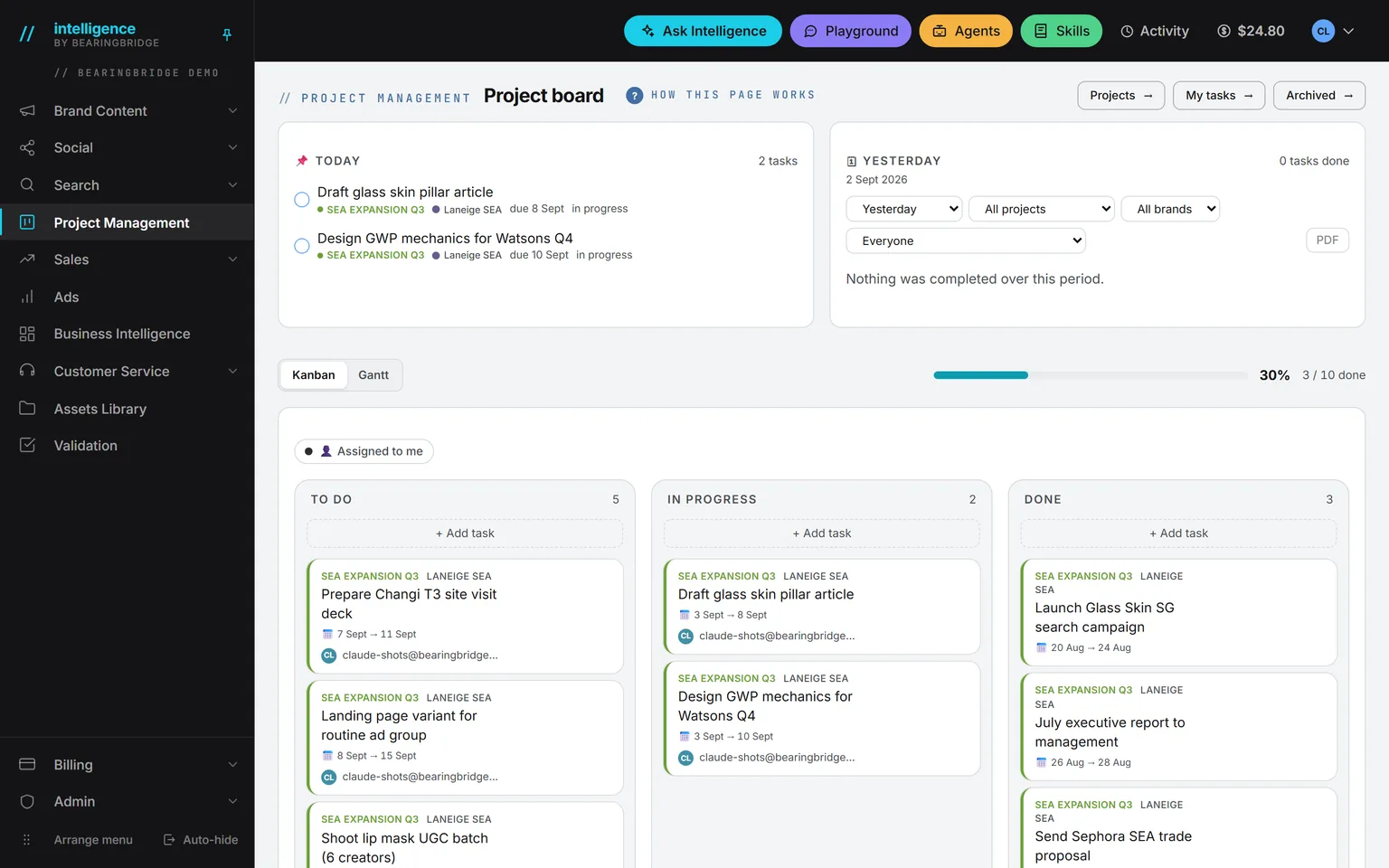
Demo workspace. Invented brand and figures.
One set of cards, four views.
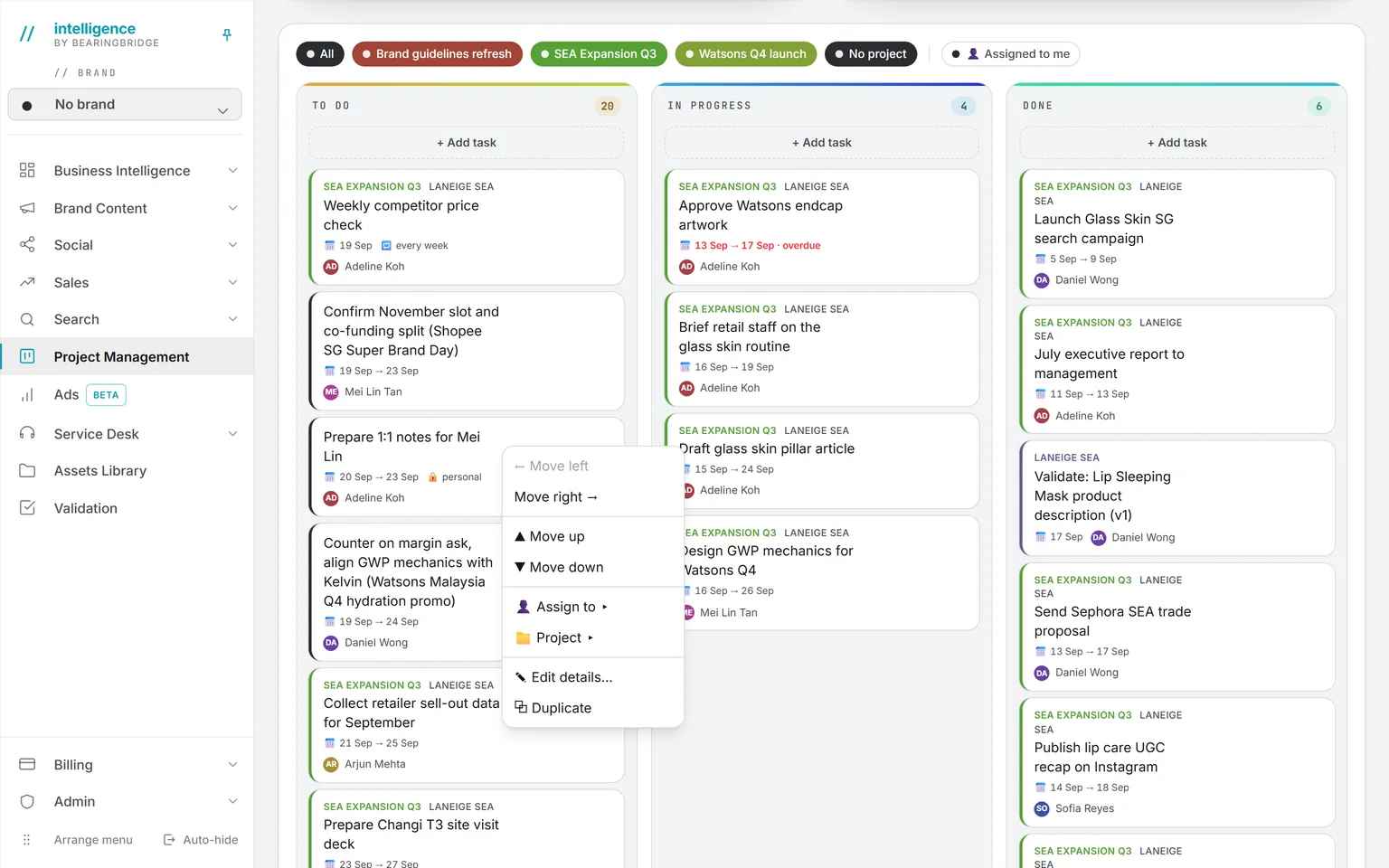
Kanban. To Do, In Progress, Done. Each card carries its project, its brand, its dates and its owner. Drag to move, drag to reorder, right-click for the rest.
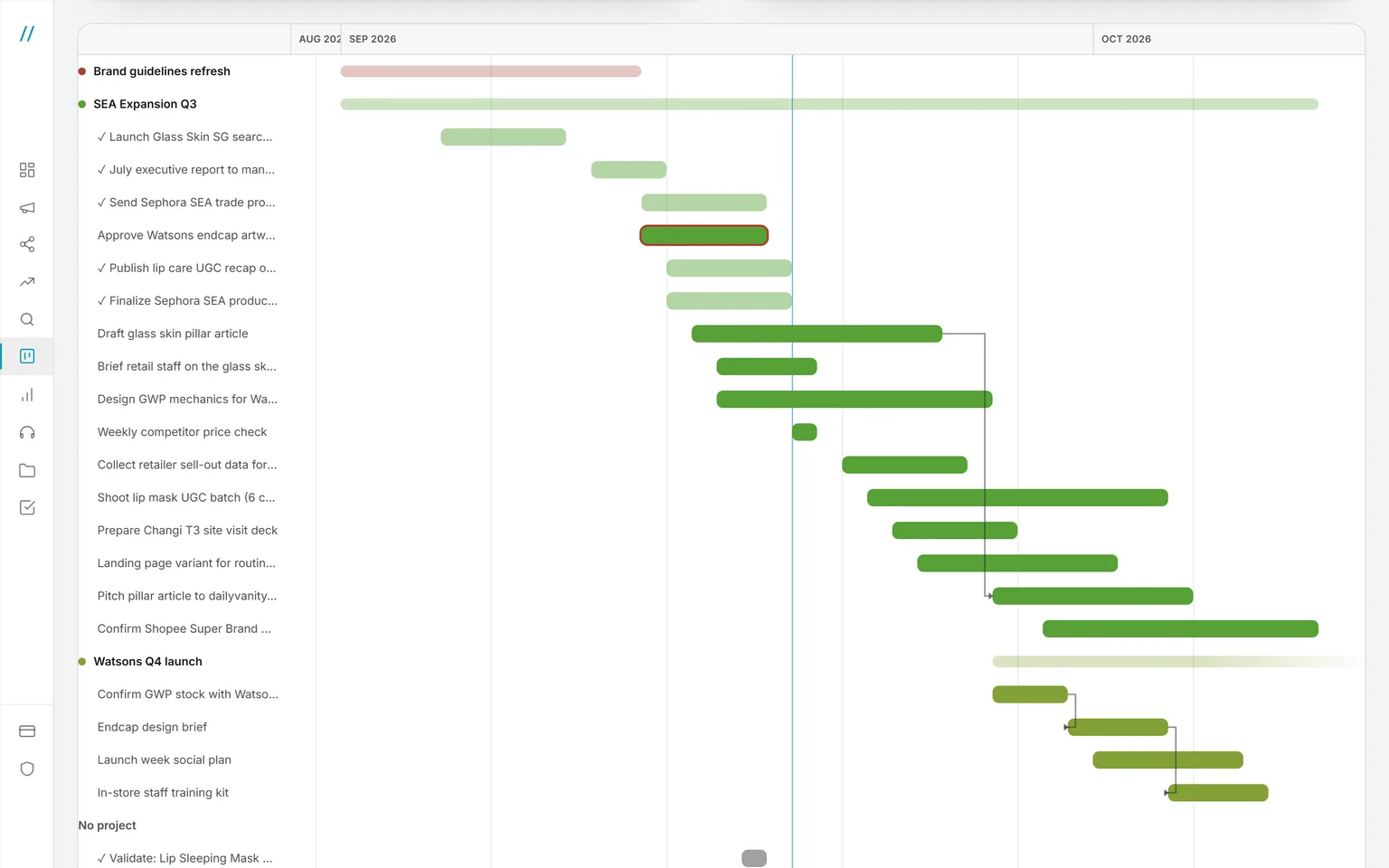
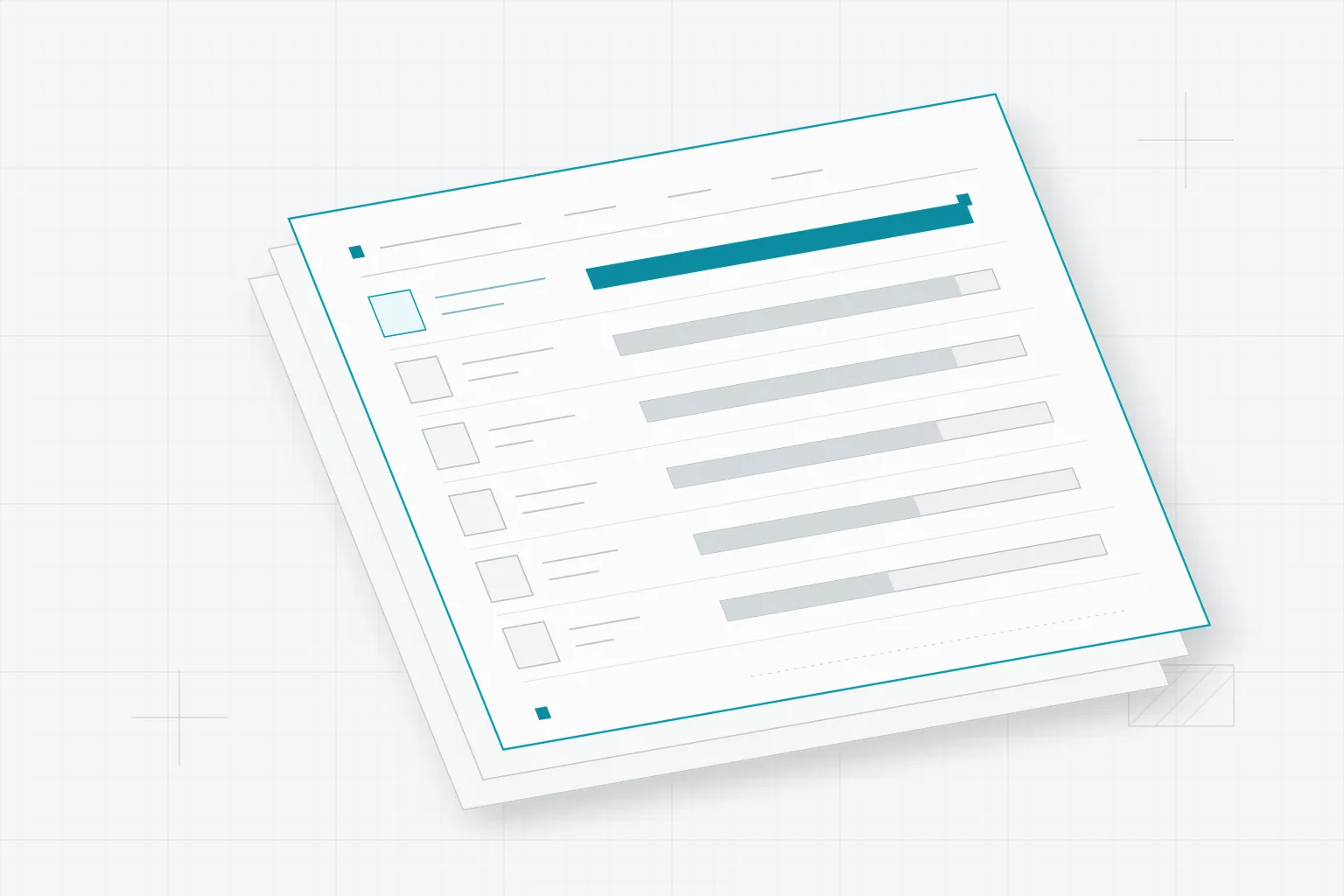
Gantt. The same cards as bars, grouped by project, with the links between a task and the one it waits on. Click a bar to edit.
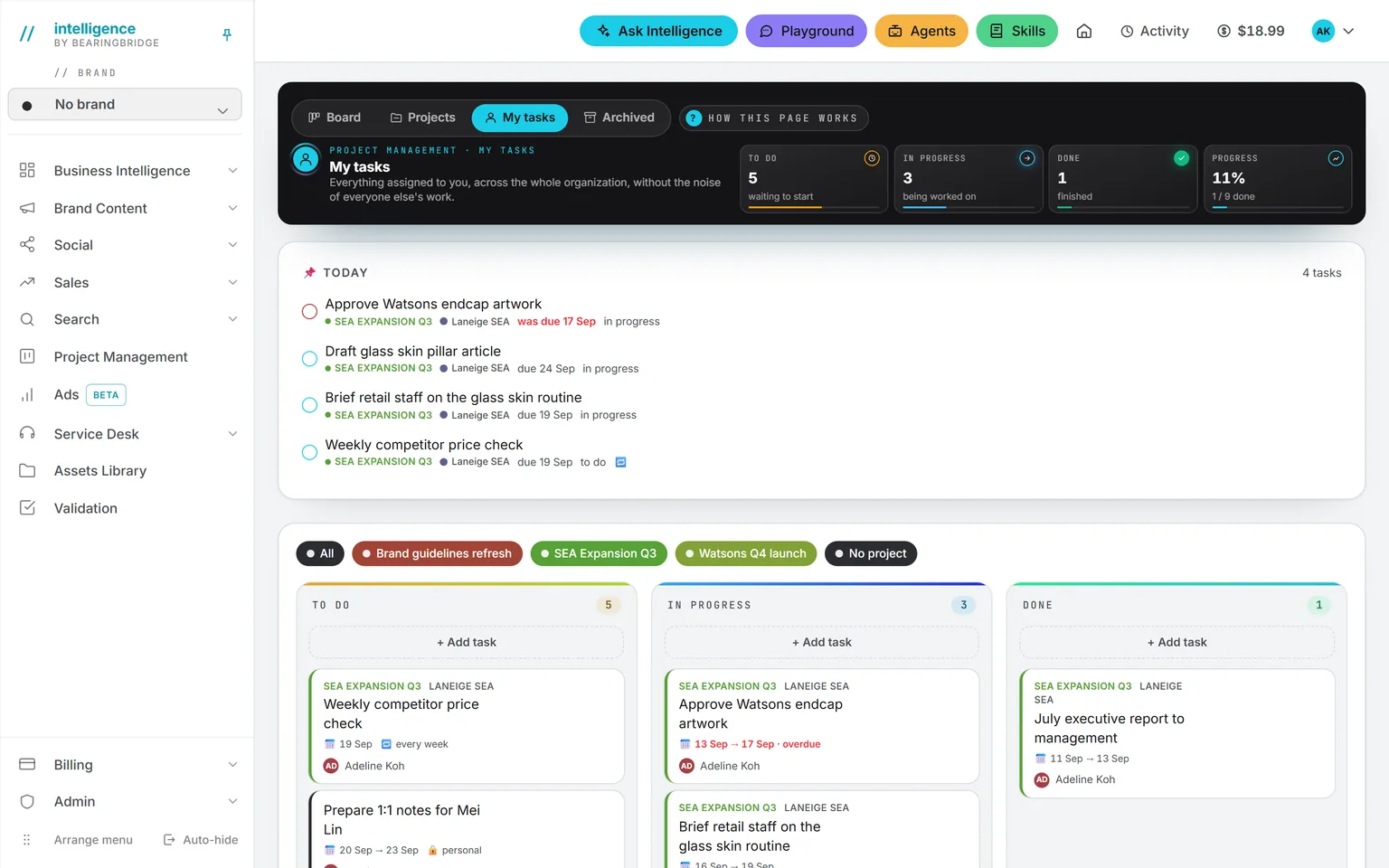
My tasks. Everything assigned to you, across the projects you are on, your private tasks included.
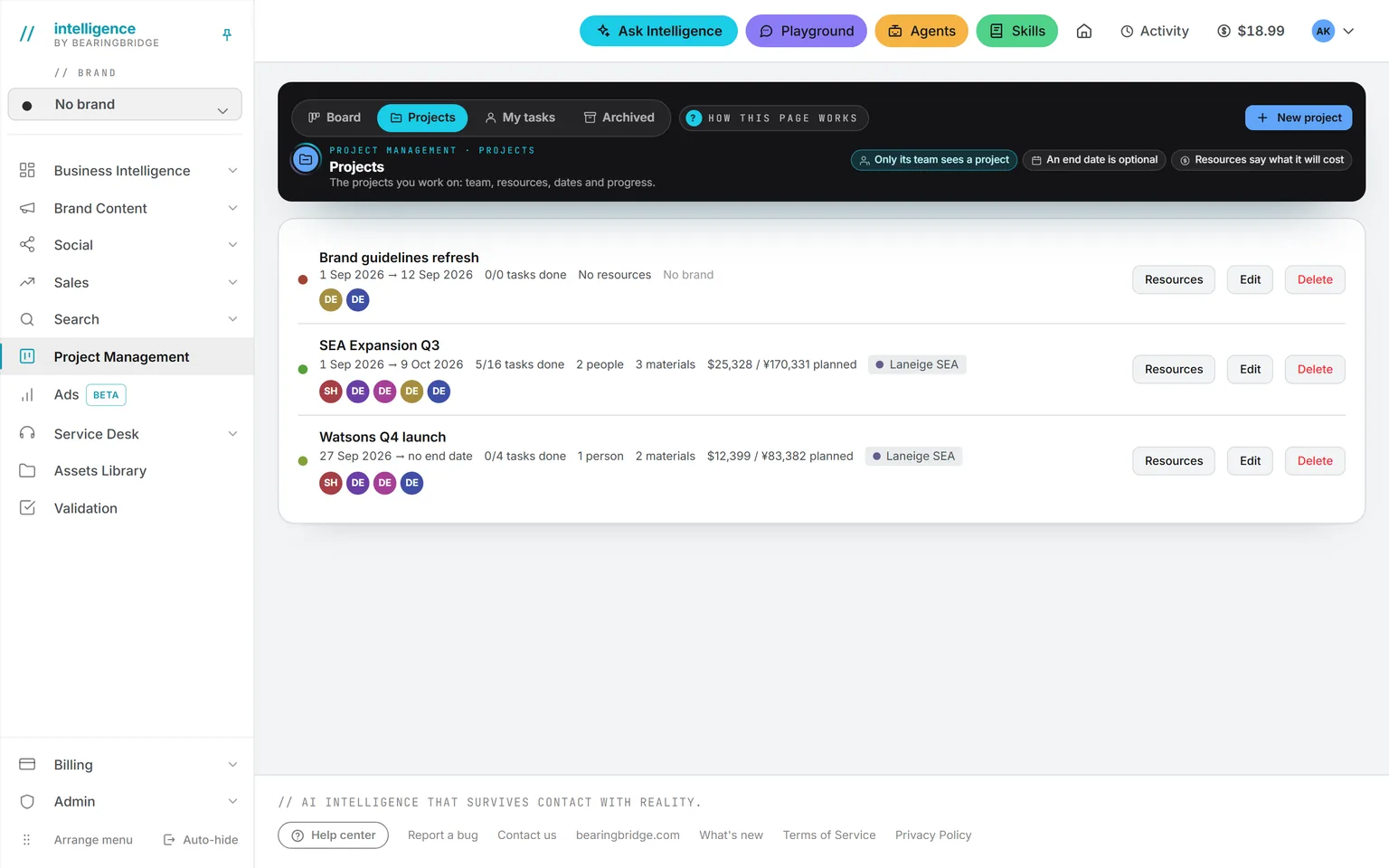
Projects. Dates, brand, the team, tasks done so far, and what the project is planned to cost.
A card is only as public as it needs to be.
A task inside a project belongs to that project’s team, plus the admins who staff it. A task outside any project belongs to just two people: you, and whoever you hand it to, admins included. Only what the product files itself, a deal step, a validation request, a post, a finding, stays open to the whole organization.
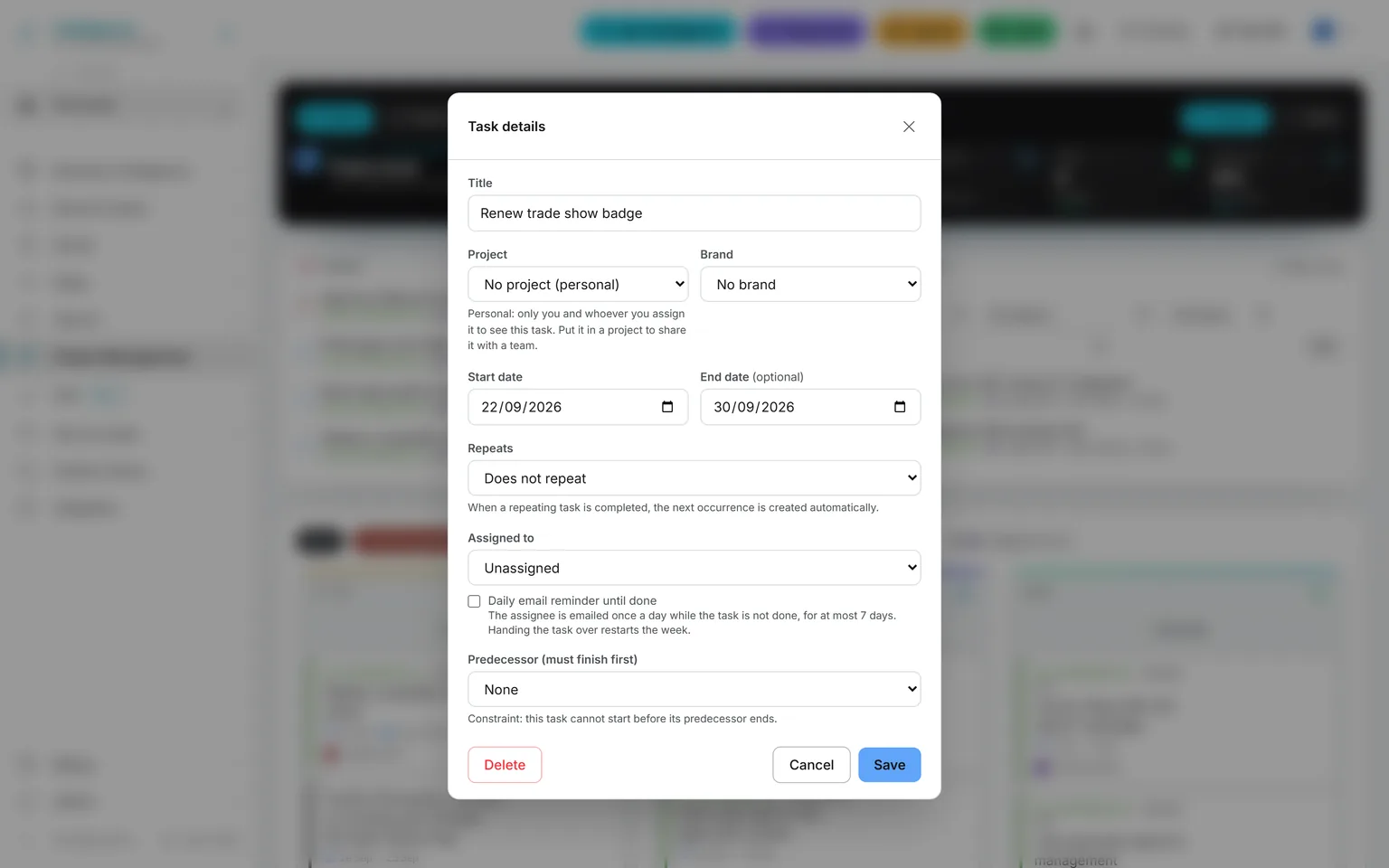
Every editor says who will see the task before you save it. Leave the project field on “No project” and the note is plain: only you and whoever you assign it to.
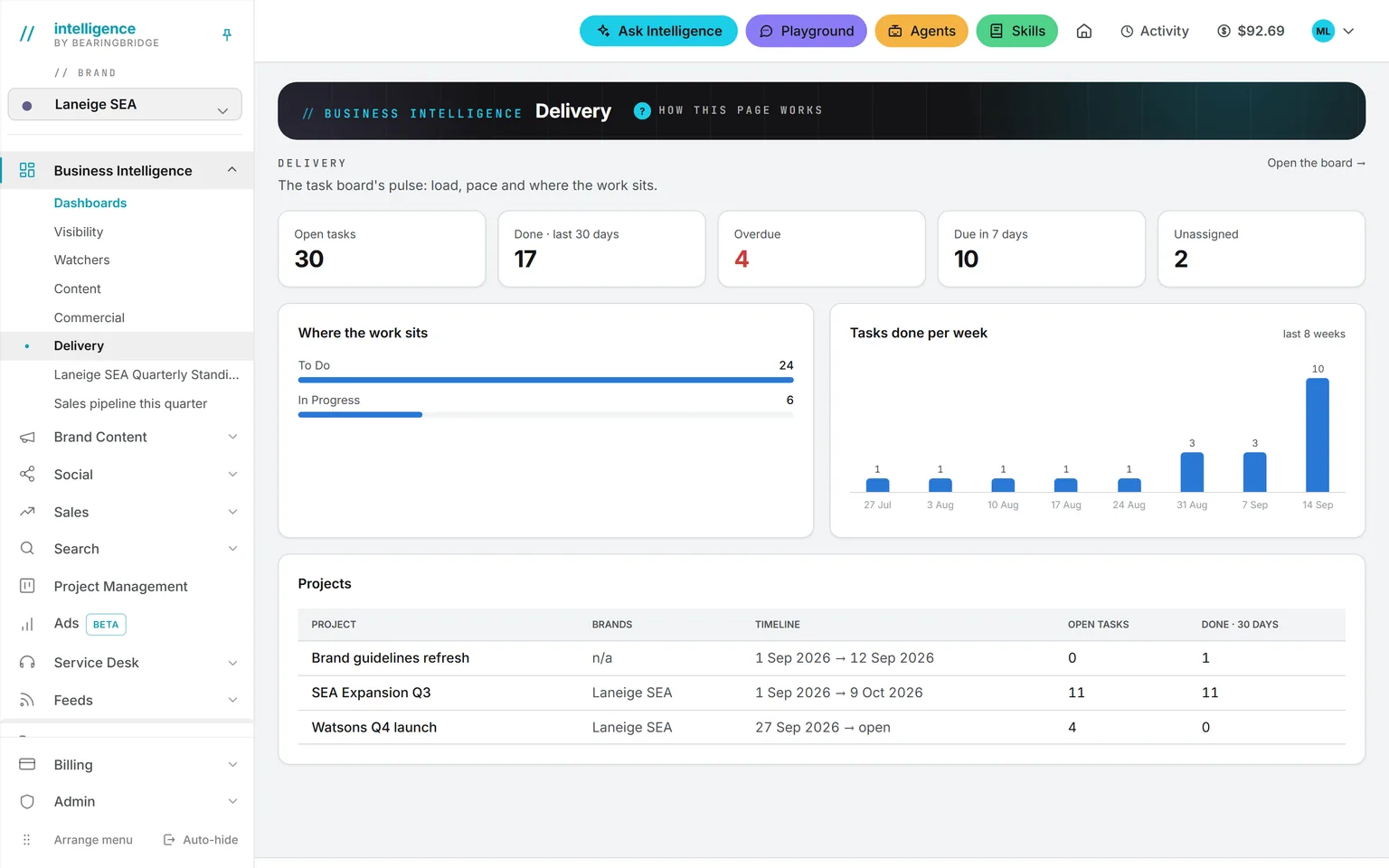
The DONE card, the PDF, the Delivery dashboard and Ask Intelligence all count only what the person looking may see.
Since September 19, 2026: projects carry a team and a planned cost, and a task outside a project is private to its author and assignee.
People and material, priced before the work starts.
An admin lists what a project needs: people, a colleague or a freelancer simply named, and material, from a studio day to a media budget. Each line carries a unit, a quantity and a cost per unit, in whatever currency it was quoted in. The total reads in your organization’s own currency, at the same exchange rates as your pipeline. Still, it’s the plan, and only the plan: no actual spend is tracked against it yet.
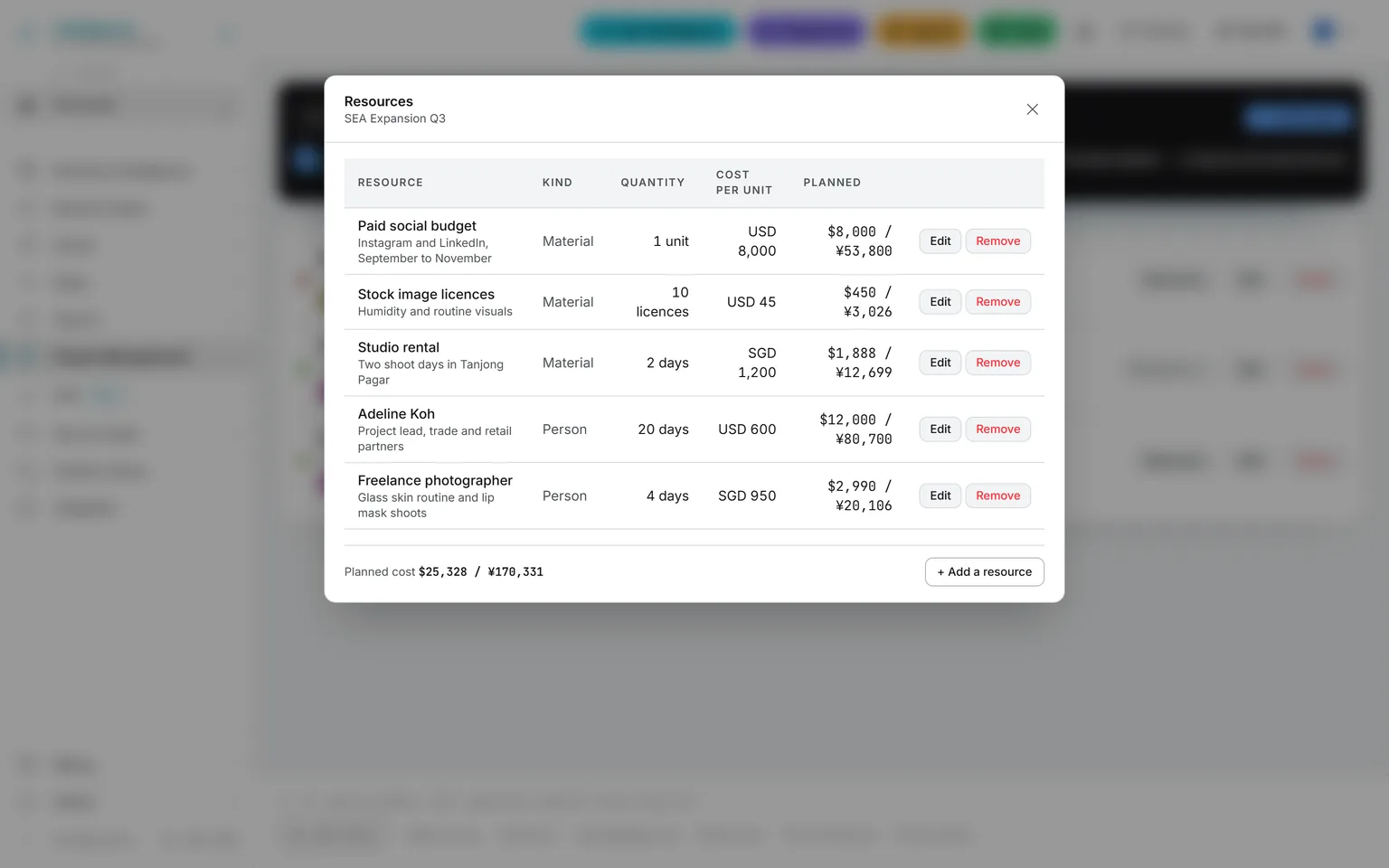
Resources. Every line priced, the total converted to your own currency.
Today for you, done for whoever’s watching.
The TODAY card is yours: what you have started, and what is due today, with late work leading in red the moment its date slips by. The DONE card shows what was finished yesterday or over the last complete weeks, filtered by project, brand or person, and exported as a landscape PDF.
A card assigned to you arrives by mail. Its owner can turn on a daily reminder: one a day, counted, seven at most, then it stops. Every date in those mails follows your own time zone and format.
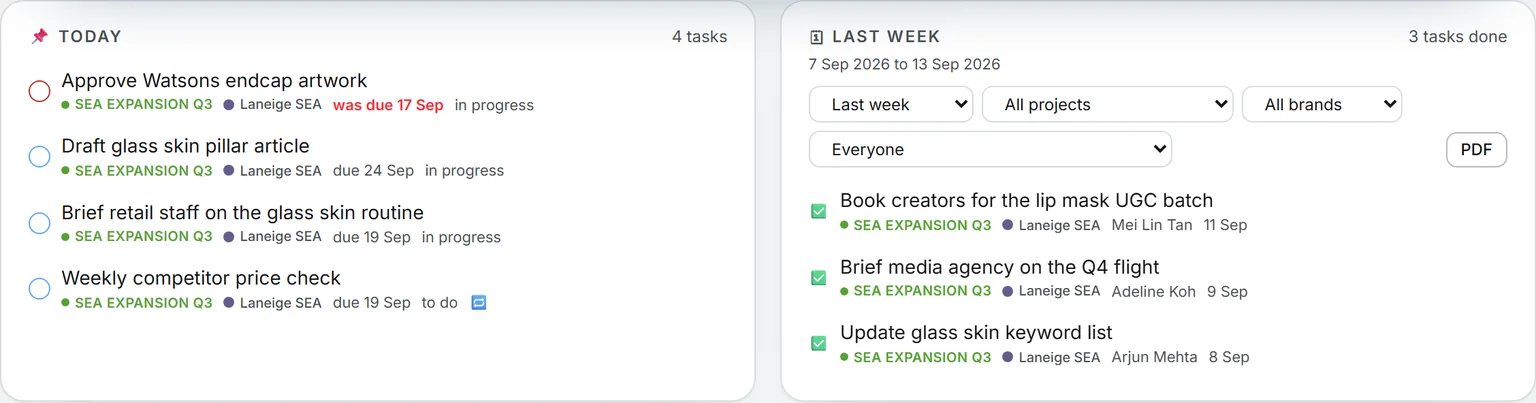
Four ways a card arrives.
From a finding
Create task under a finding puts its suggested action on the board, tagged with the brand and unassigned in To Do. The finding itself is marked as seen.
From a validation request
Send an asset to a colleague and a card appears on their board. A new version reopens it. The decision closes it.
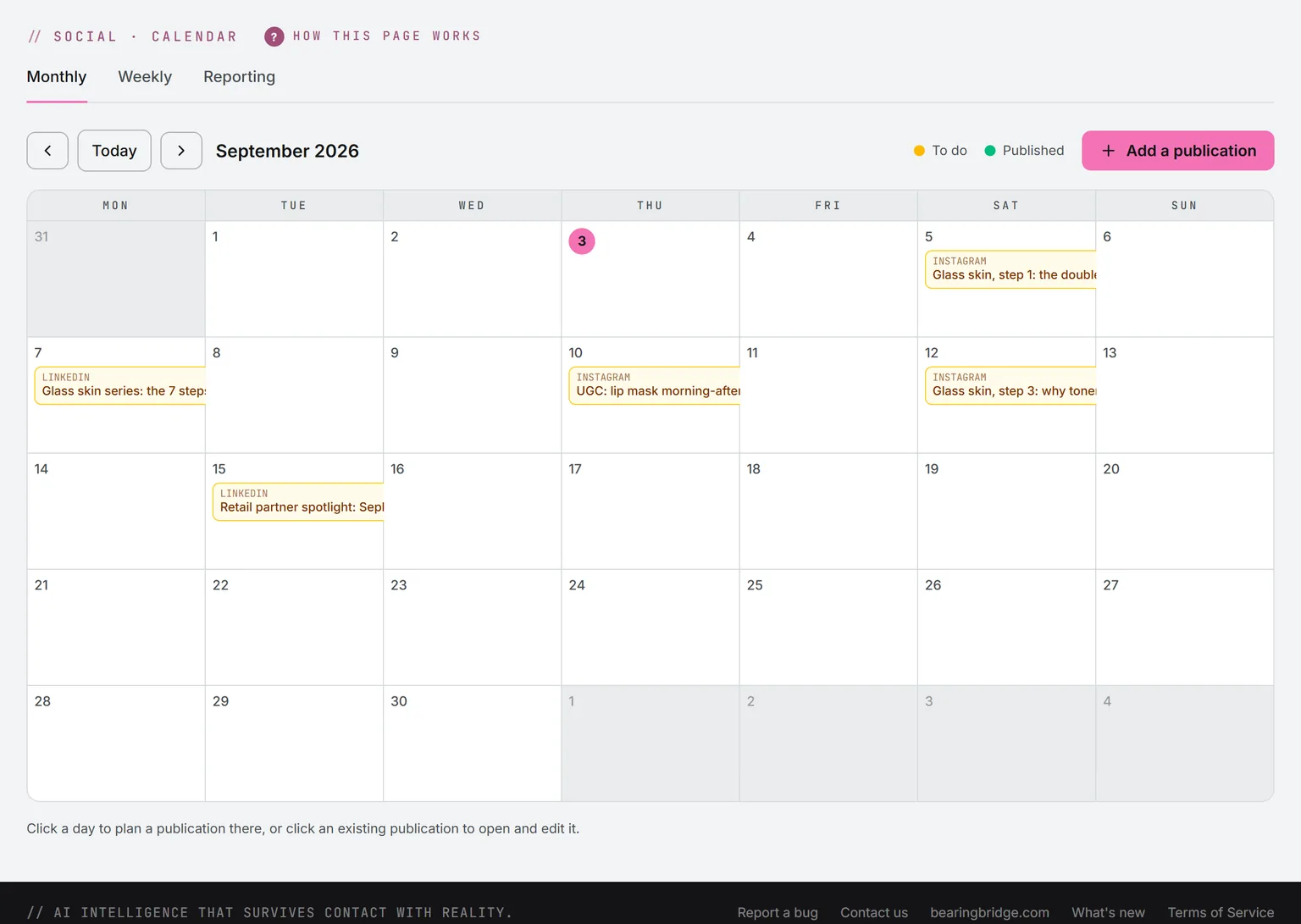
From a post
A publication planned on the Social calendar with an owner becomes a card. Published, it moves to Done by itself.
From you
Add a task and date it, then give it an owner. Put it in a project to share it with the team, or leave it without one to keep it yours.
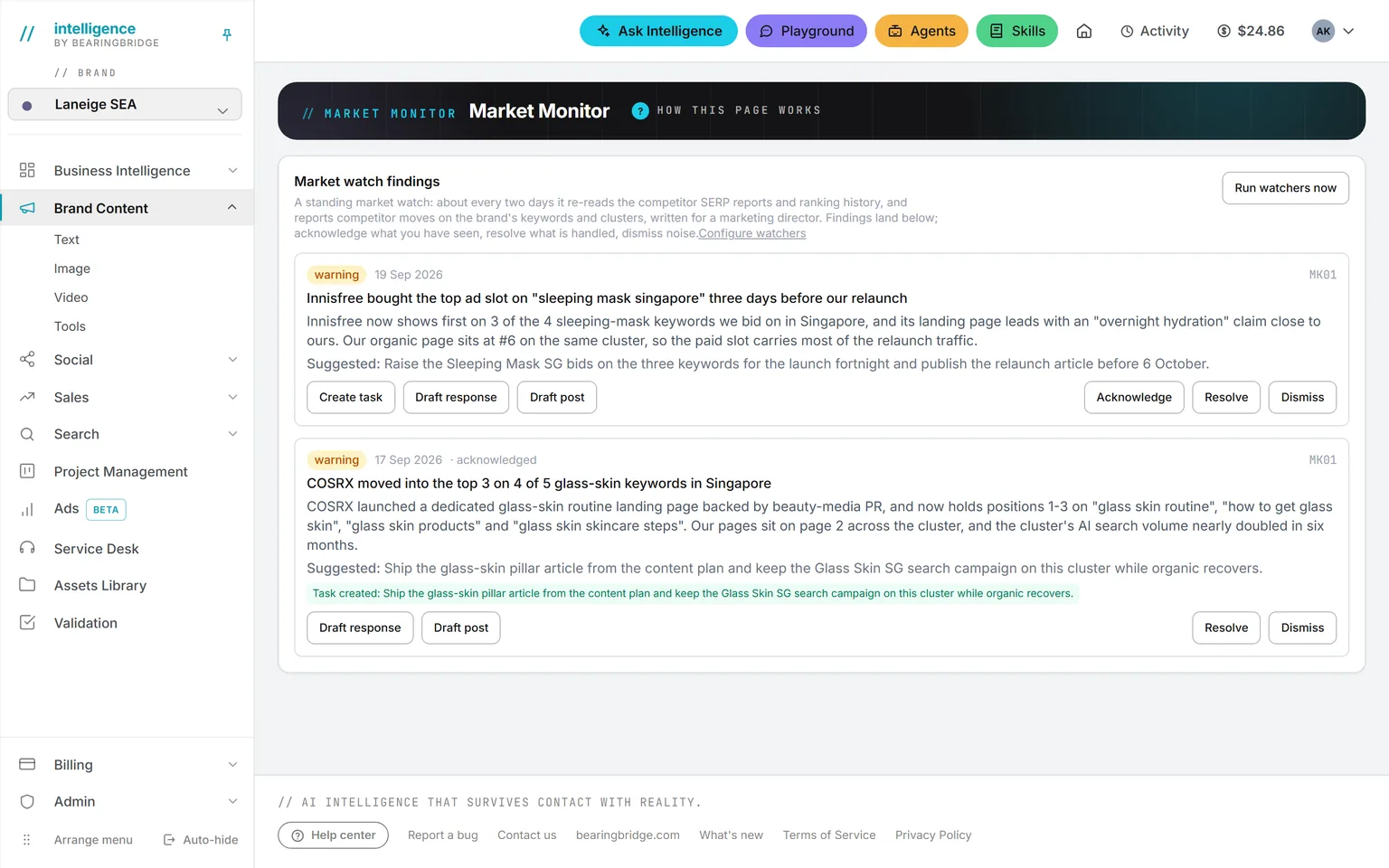
This is the point of the module. A report nobody opened changes nothing. A card with an owner and a date gets done, or gets asked about at the next stand-up.
Five rules the board keeps for you.
Only the people on a project’s team, and the admins who staff it, see the project and its tasks. A freelancer on the Watsons Q4 launch never sees a card from SEA Expansion Q3. A task outside any project is its author’s and its assignee’s.
Finish an overdue weekly task and the next one lands strictly after today, keeping its length. Daily, weekly, every two weeks, monthly.
Yesterday, last week, last two weeks, the last four weeks. Weeks run Monday to Sunday, so the running week is never counted early.
The DONE report is computed on the server from the caller’s own scope, so the file can only hold tasks that person could see.
An assignment mail, then, if the owner asks for it, one reminder a day for seven days at most, dressed in the brand when the task carries one. Dates in each mail follow the reader’s own settings.
The same data, one door over.
Nothing here is an integration. These run on the same account, the same brand, the same ledger, so a finding on one page becomes work on the next.
Not built yet, said first
- The Gantt is a timeline with one predecessor per task. No baselines, no critical path, no slip prediction.
- Planned cost only. No timesheets or capacity planning, and no actual spend set against the plan.
- Three fixed statuses. No custom columns and no work-in-progress limits.
- A card holds a title, dates, an owner and its links. No comments, attachments or checklists on the card yet.
The catalog lists every agent as built, partial, or not built. Checked against the product on October 4, 2026.
Usage is paid from a prepaid wallet, with no seat fee. The rates are on the pricing page.
Open the board on Monday and the week is already there.
Switch on Project Management, create the first project and put the team on it, and let the findings, the posts and the validation requests fill the first column.
No subscription. No seat fee. No card needed to open an account.