

AI Assistance / Agent catalog
Every agent we offer, and its real status.
Eleven standard agents you can switch on today. Forty-two more we build to order. And a public list of 66 agents, each marked built, partial, or not built, with a note that says why. We’d rather lose a deal to this page than win one and spend the next month explaining.
Snapshot of the product catalog, September 19, 2026. The IT Support family and the unbuilt service desk agents moved to built to order on September 16.
Eleven standard agents, in the product now.
These ship with every account. An administrator adds one to the organization, or a member adds one to their own agents. Each runs on a schedule with its own budget. It skips the AI call when nothing moved and still shows what the run cost. You can also build your own from your data.
Search rankings watcher
about once a day
Moves of your tracked keywords on Google, without the one-place noise.
AI visibility watcher
about every two days
What AI assistants say about you, and the citations gained or lost.
Ads campaigns watcher
about once a day
Live Google Ads campaigns that stopped serving or changed, and any that jumped in spend.
Market monitor
about every two days
Competitor moves on your keywords, written for a marketing director.
Social publishing watcher
about once a day
Every social network, one by one: a network gone quiet, an empty schedule, a failed post, or a draft stuck in validation.
LinkedIn publishing watcher
about once a day
A quiet week, an empty schedule, a failed post, or a draft stuck in validation, with the real dates.
LinkedIn Ads watcher
about once a day, yours only
Your own LinkedIn ad account, this week against last: spend jumps, costs that moved, campaigns that stopped delivering.
Web editor
about once a day, a web page
The next brief of each website’s queue, researched, written, translated, illustrated, and published once the site’s checks pass.
Verification codes
about once a day, yours only
The expired code emails of your own mailboxes, filed into a folder in Outlook or listed in Gmail, never a code shown.
Weekly operating review
every week, a document
A weekly read of what changed across your modules, with next week’s actions.
Executive report
every month, a document
A monthly narrative for the board, with numbers from your own data.
Marketing has the most built. Said plainly.
A partial counts as half, and the notes say exactly which half. Pick a family to jump to its agents. The percentage is a reading aid, not a promise. Service Desk now lists one agent, the self-service assistant, and its bar measures that one agent. The rest of that family is built to order.
Marketing
Everything that builds demand: ads, content, social, market watch, plus search visibility.
Built 5 · Partial 6 · Not built 5
Sales
Everything that converts demand: CRM, pipeline, quotes and revenue.
Built 3 · Partial 3 · Not built 11
Project Management
The work itself: boards, schedules, portfolio and delivery.
Built 1 · Partial 3 · Not built 12
Business Intelligence
One trusted picture of the business, answerable in plain language.
Built 1 · Partial 3 · Not built 12
Service Desk
Every customer conversation, handled and measured.
Built 0 · Partial 1 · Not built 0
Built to order
IT support, most service desk work, and the agents we’ve built for clients. Scoped, priced, and built for one organization at a time.
Not product features
Filter by status. Read the note.
Partial means part of it ships today, and the note under it says which part does not. Not built means precisely that: nothing to click yet, and no date promised.
Marketing
The module pageTracks competitor sites, pricing, launches, positioning, hiring, ad activity.
Search competitors and the Market monitor agent ship: it reports competitor moves from your stored search results. Pricing, launches, hiring, and ad activity are not watched yet.
Rankings by market, language, and search intent.
Tracked keywords with rank checks by market and language, plus the Search rankings watcher.
What assistants answer when asked about your category, and which sources they cite.
The AI visibility panel, with mentions, answers, and cited sources, plus the AI visibility watcher.
Topic and campaign pipeline.
Content plans built from market gaps: every proposed article carries the ranking and search evidence behind it.
Approved claims, evidence, and expiry dates.
Not built.
Site pages, articles, landing pages.
Content plans, blog articles, landing pages.
One-pagers, decks, battlecards, case sheets.
Not built.
Google campaigns from budget to search term.
Full Google Ads lifecycle: build, push, launch, sync.
Meta, TikTok, LinkedIn campaigns and creative sets.
The LinkedIn Ad Library, read-only. No campaign creation on Meta, TikTok, or LinkedIn.
Planning calendar, scheduling, publishing.
The calendar, drafting, reporting, and publishing on LinkedIn, Facebook, X, Instagram, and TikTok ship. YouTube videos and the channel kit are prepared here and published by hand in YouTube Studio.
Market and language adaptation.
Not built.
Images, video, documents, versions, rights.
Image and video generation, an image anonymizer, and the Assets Library with folders, tags, and brand visibility. No versions or rights tracking yet.
Push to your CMS with review states.
Not built.
Lists, sequences, sends.
Not built.
Brief to result, per campaign.
Google Ads sync plus the Ads campaigns watcher. No cross-channel attribution.
Dashboard across channels and markets.
The Executive report is a standard agent. No cross-channel dashboard yet.
Sales
The module pageAccounts, contacts, activity, relationships.
Clients, suppliers, contacts, activities.
Opportunities through your stages.
Deal board, stages, next-step.
Inbound to owner.
Not built.
Calls, transcripts, notes into the record.
Not built.
Catalog, configurations, validity rules.
Not built.
Configure, price, quote.
Proposal drafting left the deal page. It is offered as an agent built to order.
Discount and terms gates.
Not built.
Proposals and statements of work.
Offered as an agent built to order.
Signed to booked.
Not built.
Issue, track, credit.
The billing module sells prepaid AI credits. No general sales invoicing.
Receipts, aging, chasing.
Not built.
Commit, best case, pipeline.
Revenue Follow Up covers P&L, costs, and cashflow, in beta and not open to customers yet. No commit or best-case forecast.
Coverage and targets.
Not built.
Calculation and statements.
Not built.
Renewal calendar, risk register.
Not built.
Activity, conversion, velocity.
A CRM dashboard. No conversion or velocity analysis.
P&L, costs, cashflow.
Built, in beta, and not open to customers yet: P&L, costs, and cashflow.
Project Management
The module pageBoards, columns, cards, WIP limits.
Boards, recurrence, assignees.
Schedules, baselines, critical path.
A basic Gantt. No slip prediction.
All projects, one picture.
Partial.
Who is on what, and what is left.
Not built.
Time capture per project and task.
Not built.
Cost tracking per project.
Not built.
What blocks what.
Not built.
Stage reviews and approvals.
Not built.
Risks, owners, mitigations.
Not built.
Scope changes, impact, approval.
Not built.
Updates to stakeholders.
Not built.
Decisions into work.
Not built.
Per project, versioned.
Not built.
External visibility, controlled.
A login limited to one brand. No curated client view.
What happened, logged.
Not built.
Delivery, margin, utilization.
Not built.
Business Intelligence
The module pageERP, CRM, PLM, PIM, MES, HR, finance, ad platforms, spreadsheets.
Google Ads, LinkedIn, and search data, plus the systems you connect: MCP servers, REST APIs, Zoho, and a Google account.
Agreed definitions for every business metric.
Not built.
Governed layer between questions and tables.
Not built.
Business questions, answered.
Ask Intelligence answers from your own data, over none, one, or several brands, with the cost of every answer recorded.
Views by role and function.
Not built.
From chart to source record.
Not built.
Where every number comes from.
Not built.
When was this last correct.
Not built.
ERP against CRM, CRM against finance.
Not built.
Something moved.
The Ads campaigns watcher flags campaign anomalies. Other data sources are not covered.
Thresholds and conditions.
Not built.
Reports to people, on time.
Agents can mail their findings or report after each scheduled run. No general report distribution yet.
Periodic reporting pack.
The Weekly operating review is a standard agent. No assembled multi-page pack yet.
What if.
Not built.
Who sees which rows.
Not built.
Who took what data out.
Not built.
Service Desk
The module pageAssistant on your channels.
A public assistant that answers from your documents on its own page or in a chat bubble on your site, and hands over to a person when it cannot answer. No third-party channels yet.
No agent with this status in this family.
Forty-two more, built for you. Not product features.
Tailor-made work is priced as a project, after scoping, and the agent’s runs are billed like any other AI action. Ten of these we’ve already built for client organizations. The others we build when someone asks, IT support and most service desk work among them. Each one is scoped before it’s priced, and it stays yours.
Inside the product they sit in the Tailor made section of the agent catalog, each with a link to ask for it. We list them here too, since none of them is a feature you can turn on by yourself.
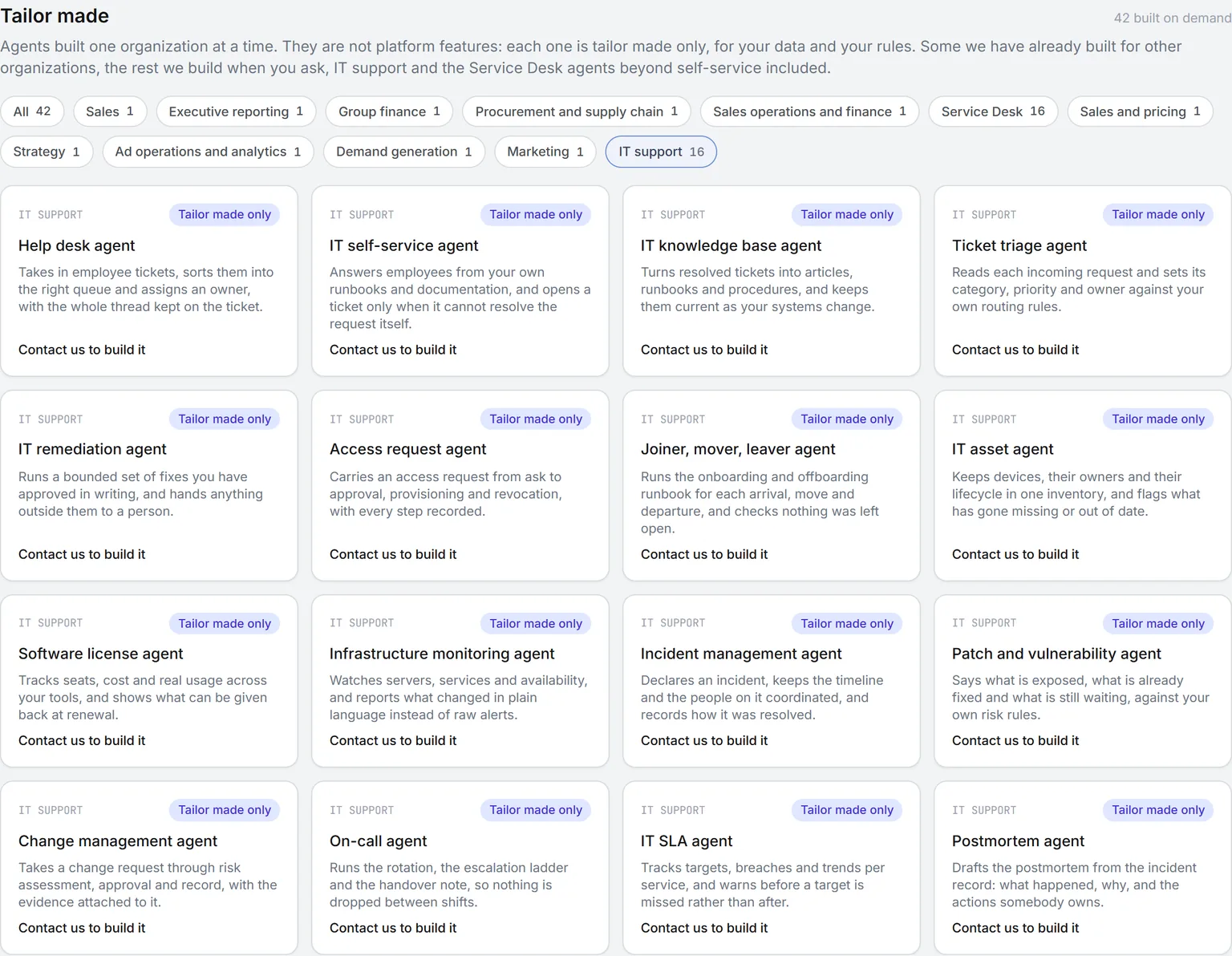
Takes in employee tickets, sorts them into the right queue and assigns an owner, with the whole thread kept on the ticket.
Answers employees from your own runbooks and documentation, and opens a ticket only when it cannot resolve the request itself.
Turns resolved tickets into articles, runbooks and procedures, and keeps them current as your systems change.
Reads each incoming request and sets its category, priority and owner against your own routing rules.
Runs a bounded set of fixes you have approved in writing, and hands anything outside them to a person.
Carries an access request from ask to approval, provisioning and revocation, with every step recorded.
Runs the onboarding and offboarding runbook for each arrival, move and departure, and checks nothing was left open.
Keeps devices, their owners and their lifecycle in one inventory, and flags what has gone missing or out of date.
Tracks seats, cost and real usage across your tools, and shows what can be given back at renewal.
Watches servers, services and availability, and reports what changed in plain language instead of raw alerts.
Declares an incident, keeps the timeline and the people on it coordinated, and records how it was resolved.
Says what is exposed, what is already fixed and what is still waiting, against your own risk rules.
Takes a change request through risk assessment, approval and record, with the evidence attached to it.
Runs the rotation, the escalation ladder and the handover note, so nothing is dropped between shifts.
Tracks targets, breaches and trends per service, and warns before a target is missed rather than after.
Drafts the postmortem from the incident record: what happened, why, and the actions somebody owns.
Triages, retrieves and drafts answers to routine customer inquiries, under a conservative escalation rule.
Brings email, chat, voice, messaging apps and social into one queue, with the same customer recognized across all of them.
Drafts the reply from your own history and tone of voice; the agent handling the case decides what actually goes out.
Keeps macros, templates and snippets in one place and offers the right one inside the conversation.
Puts the customer’s orders, account and past contacts at the agent’s elbow before they answer.
Carries a warranty, return or claim from request to resolution, with the exceptions queued for a person.
Watches targets and timers per conversation and escalates on your own paths before a promise is broken.
Asks after contact, collects the answers and shows what actually moved satisfaction, not just the average.
Reviews interactions against your quality grid and shows each score with the passage it came from.
Turns quality reviews into per-agent coaching, with concrete examples from their own conversations.
Builds an account-level service picture: volume, sentiment, open issues and where the relationship stands.
Handles inbound and outbound in the customer’s own language, written natively rather than translated.
Reads what customers actually say across every channel and reports the themes with the quotes behind them.
Contacts the customer before they complain, on the signals you decide are worth a message.
Tracks serious cases from first contact to closure, with deadlines, owners and the record a regulator would ask for.
Reports volume, resolution, cost and quality in one place, on definitions everyone has agreed.
Drafts a client-ready quote or proposal from a deal’s CRM context: client, amounts, next steps and activity history, in your templates and tone.
One dashboard over every system, with agreed metric definitions, that leadership can question in plain language.
Coding, matching and commentary drafting for the monthly close, with the ledger itself left untouched.
Extracts supplier documents and three-way matches them at confirmation, with an exception queue for people.
Scenario forecasts as ranges with logged assumptions, owned and decided by people.
Assembles quotations from client context and written pricing logic; sales checks and sends.
Reads market sources across languages and writes weekly briefings backed by dated primary sources.
Normalizes campaign data across ad platforms against a metric dictionary, showing source disagreement openly.
Drafts, tests and adjusts campaigns across ad platforms from one workspace.
Produces on-brand assets at scale from brand context packs, with a hard legal gate before anything ships.
Take what is built. Ask for the rest.
When an entry changes status, the changelog says so the same week, and this list is updated from the product.
No subscription. No seat fee. No card needed to request an account.