
Skip to content

Intelligence Layer

One account, one ledger, one agent layer. The modules are what you switch on.

Platform overview
The AI Intelligence Layer

One intelligence layer under every module: the same data, the same agents, the same ledger, whichever function you switch on.

  • One layer, every module
  • Shared data and agents
  • Every run on one ledger
Go to The AI Intelligence Layer
Isometric stack of pale grey slabs wired together on white, with one layer filled deep cyanStart hereThe architecture is the argumentWhy adding the sixth module costs a fraction of buying the first.Read the architecture
The Architecture

One account carries every brand you run. Modules are switched on per brand, and every run lands in the same ledger.

  • One account, many brands
  • Modules toggle per brand
  • A single billing ledger
Go to The Architecture
Isometric stack of pale grey slabs wired together on white, with one layer filled deep cyanStart hereThe architecture is the argumentWhy adding the sixth module costs a fraction of buying the first.Read the architecture
The agent layer

Three kinds of agent. Watchers notice, drafters produce, and Ask Intelligence answers from your own numbers.

  • Watchers run on a schedule
  • Drafters wait for sign-off
  • Answers carry their source
Go to The agent layer
Isometric stack of pale grey slabs wired together on white, with one layer filled deep cyanStart hereThe architecture is the argumentWhy adding the sixth module costs a fraction of buying the first.Read the architecture
Security

Isolated tenancy, roles that mean something, and a plain answer about what leaves your account.

  • Per-tenant isolation
  • Roles down to the module
  • Stated data boundaries
Go to Security
Isometric stack of pale grey slabs wired together on white, with one layer filled deep cyanStart hereThe architecture is the argumentWhy adding the sixth module costs a fraction of buying the first.Read the architecture

Seats are free — you pay for what the AI runs

Book a demoOpen your account

Capabilities

The AI you work with directly, and the modules it already runs. Take one, or take them all.

See all modules

AI Assistance

Work with the AI directly

Ask Intelligence

Ask a business question in plain words. It reads your own data through read-only tools scoped to the brand, and answers with the real figure or says the data is not there.

  • Fifteen read-only tools
  • Scope enforced in code
  • Never invents a number
Go to Ask Intelligence
Playground

A direct chat with the models your administrator allows. No brand data: the model sees the conversation, your files and your instructions.

  • Compare three models side by side
  • Files in, documents out
  • The price under every answer
Go to Playground
Agents

Three kinds of agent do the standing work: watchers notice, drafters produce, and nothing ships until someone with the role signs.

  • Watchers run on a schedule
  • Drafters wait for sign-off
  • Every run lands on the ledger
Go to Agents
Skills

How a brief is built, how a campaign is structured, what a decent article looks like — the craft of the people who built this, shipped as the default setting.

  • Senior practice built in
  • Defaults you adjust
  • Nothing to write from scratch
Go to Skills

Modules & Features

The functions it runs

Business Intelligence

Ask your business a question in plain words and get the real number back, with the source that produced it.

  • Plain-language questions
  • Every figure sourced
  • Board-ready reporting
Go to Business Intelligence
Project Management

The board where an insight becomes a card with an owner, instead of a dead report nobody actions.

  • Kanban with a timeline
  • One click, insight to task
  • Owner and date attached
Go to Project Management
Sales

Pipeline that drafts its own paperwork, and flags the deals that went quiet before you notice.

  • Quotes off the deal record
  • Quiet deals surfaced
  • Revenue projected forward
Go to Sales
Brand Marketing

The content engine and the Creative Studio behind the brand: articles buyers actually search for, and the images and video that carry them.

  • Eight-stage content engine
  • Creative Studio built in
  • Drafts wait for sign-off
Go to Brand Marketing
Social

Posts drafted from work you have already approved — an article becomes the thread, a launch becomes the post — on a calendar you sign.

  • Drafts from approved work
  • A calendar you sign
  • One voice on every network
Go to Social
Search

Watches where you rank, ties every position to the page that earned it, and says what to write next — with GEO watching the AI assistants.

  • Rank tracked continuously
  • Positions tied to pages
  • GEO polls the assistants
Go to Search
Ads

Search campaigns arrive built — ad groups, keywords, copy — priced before they run, and paused the moment they stop earning.

  • Campaigns priced first
  • Ad groups arrive built
  • Paused when they slip
Go to Ads
Customer Service

Answers from what you gave it, on your own page, and it says so plainly when it does not know.

  • Grounded in your content
  • Refuses to invent
  • Escalates to a human
Go to Customer Service
IT Support

The support desk turned inward: employees ask, it answers from your own systems and documentation, and escalates what it cannot resolve.

  • Answers from your docs
  • Tickets triaged first
  • Escalates to a human
Go to IT Support

Seats are free — you pay for what the AI runs

Book a demoOpen your account

Services

The people around the product, from the first connection to a named operator on your account.

All services
Onboarding

A guided session to connect your data and switch on the first function, then a first week planned day by day.

  • One guided session
  • First function live in a week
  • A person on the other end
Go to Onboarding
A fanned stack of white ruled sheets with the top one edged in deep cyanLarger organizationsRoll out by brand, by team, by functionOne account, one ledger, roles down to the function. Staged so procurement never has to open a file.See the group rollout
Data integration

We connect the systems you already run and prepare the data behind them, so every answer has a source.

  • Connectors built and tested
  • Metrics defined once
  • Sources reconciled
Go to Data integration
A fanned stack of white ruled sheets with the top one edged in deep cyanLarger organizationsRoll out by brand, by team, by functionOne account, one ledger, roles down to the function. Staged so procurement never has to open a file.See the group rollout
Intelligence audit

A fixed-price review of where you rank, what the AI assistants answer, and which function pays back first.

  • Four assistants polled
  • Search position by market
  • A ranked starting point
Go to Intelligence audit
A fanned stack of white ruled sheets with the top one edged in deep cyanLarger organizationsRoll out by brand, by team, by functionOne account, one ledger, roles down to the function. Staged so procurement never has to open a file.See the group rollout
Training

Sessions for the people who will approve, review and ask, so the workforce is used rather than watched.

  • By role, not by feature
  • Live on your account
  • Recorded for the next hire
Go to Training
A fanned stack of white ruled sheets with the top one edged in deep cyanLarger organizationsRoll out by brand, by team, by functionOne account, one ledger, roles down to the function. Staged so procurement never has to open a file.See the group rollout
Managed operations

Someone reviews what the watchers found, approves the drafts within your caps, and runs the weekly review.

  • Drafts approved in your name
  • Caps respected
  • Weekly review delivered
Go to Managed operations
A fanned stack of white ruled sheets with the top one edged in deep cyanLarger organizationsRoll out by brand, by team, by functionOne account, one ledger, roles down to the function. Staged so procurement never has to open a file.See the group rollout
Custom features

An agent or a function built for your process, on the same ledger and under the same approval gates.

  • Scoped before it is priced
  • Same gates, same ledger
  • Yours to keep
Go to Custom features
A fanned stack of white ruled sheets with the top one edged in deep cyanLarger organizationsRoll out by brand, by team, by functionOne account, one ledger, roles down to the function. Staged so procurement never has to open a file.See the group rollout
Dedicated hosting

A single-tenant deployment in the region you choose, with the data boundary written down and an uptime commitment.

  • Single tenant
  • Region of your choice
  • Uptime in writing
Go to Dedicated hosting
A fanned stack of white ruled sheets with the top one edged in deep cyanLarger organizationsRoll out by brand, by team, by functionOne account, one ledger, roles down to the function. Staged so procurement never has to open a file.See the group rollout
Premium Support

A named contact, committed response times, and a quarterly review of what ran, what it cost and what to change.

  • Named contact
  • Committed response times
  • Quarterly review
Go to Premium Support
A fanned stack of white ruled sheets with the top one edged in deep cyanLarger organizationsRoll out by brand, by team, by functionOne account, one ledger, roles down to the function. Staged so procurement never has to open a file.See the group rollout

Seats are free — you pay for what the AI runs

Book a demoOpen your account

About

Why this was built, who is behind it, what it has done for the companies running it, and how to run it well.

About BearingBridge
Why we built it?

What a company can do has been capped by who it could afford to hire. That cap is the thing that moved.

  • Capability, not headcount
  • Written, not benchmarked
  • No lock-in claim
Go to Why we built it?
A row of pale grey blocks climbing steeply to a single tall deep cyan block, a hairline curve tracing the riseThe short versionPunch above your headcountThe AI workforce for companies that need more capability than they can staff.Read the argument
Who is behind BearingBridge?

Who built this, what it is independent of, and why that independence is worth stating out loud.

  • Model-independent
  • No data resale
  • Named people behind it
Go to Who is behind BearingBridge?
A row of pale grey blocks climbing steeply to a single tall deep cyan block, a hairline curve tracing the riseThe short versionPunch above your headcountThe AI workforce for companies that need more capability than they can staff.Read the argument
How we run the work

The six-phase method every account is built on: a written bearing, a dated baseline, a pilot on real data, and a fix that reconciles the money.

  • A kill criterion, in writing
  • Costs watched as they run
  • An ending without us
Go to How we run the work
A row of pale grey blocks climbing steeply to a single tall deep cyan block, a hairline curve tracing the riseThe short versionPunch above your headcountThe AI workforce for companies that need more capability than they can staff.Read the argument
Case studies

Ten builds told the way they ran: the situation, what was built, what changed months later, and what got switched off.

  • Sector and function stated
  • Client-verified figures
  • The stopped work left in
Go to Case studies
A row of pale grey blocks climbing steeply to a single tall deep cyan block, a hairline curve tracing the riseThe short versionPunch above your headcountThe AI workforce for companies that need more capability than they can staff.Read the argument
FAQ

The questions that come up before every demo, answered here so the demo can be about your business.

  • Product and billing
  • Security and data
  • Answered in plain words
Go to FAQ
A row of pale grey blocks climbing steeply to a single tall deep cyan block, a hairline curve tracing the riseThe short versionPunch above your headcountThe AI workforce for companies that need more capability than they can staff.Read the argument
Testimonials

Customers on the module they actually run, quoted directly, with the module named.

  • Module named each time
  • Quoted, not paraphrased
  • Role and size given
Go to Testimonials
A row of pale grey blocks climbing steeply to a single tall deep cyan block, a hairline curve tracing the riseThe short versionPunch above your headcountThe AI workforce for companies that need more capability than they can staff.Read the argument
Changelog

What shipped, dated, newest first. The place to check whether the thing you were promised exists yet.

  • Dated entries
  • Shipped only
  • Linked to the module
Go to Changelog
A row of pale grey blocks climbing steeply to a single tall deep cyan block, a hairline curve tracing the riseThe short versionPunch above your headcountThe AI workforce for companies that need more capability than they can staff.Read the argument
Partner program

Run the platform for the companies you advise. Every client is a brand on your account, billed on its own ledger.

  • Clients as brands
  • Separate ledgers
  • Margin on every run
Go to Partner program
A row of pale grey blocks climbing steeply to a single tall deep cyan block, a hairline curve tracing the riseThe short versionPunch above your headcountThe AI workforce for companies that need more capability than they can staff.Read the argument

Seats are free — you pay for what the AI runs

Book a demoOpen your account

Pricing

Seats are free. You pay for what the AI actually runs, and you see the price first.

Full pricing
How it works

Three sentences, and that is the whole model. No tiers to decode, no per-seat arithmetic to do.

  • No seat licence
  • No annual lock-in
  • Three sentences long
Go to How it works
Ten pale meter tracks filled to different levels in deep cyan, cut by one horizontal cyan limit lineNo surprisesYou see the price before you run itThe price, the caps and the gates, all visible before anything spends.Open pricing
Seats

Give an account to everyone who needs one. The number on the invoice does not move when you do.

  • Unlimited accounts
  • Zero per-seat cost
  • Roles still enforced
Go to Seats
Ten pale meter tracks filled to different levels in deep cyan, cut by one horizontal cyan limit lineNo surprisesYou see the price before you run itThe price, the caps and the gates, all visible before anything spends.Open pricing
What things cost

Every run is priced from your wallet before or as it runs, and the machine’s own mistakes are not billed to you.

  • Quoted before it runs
  • Retries are on us
  • Itemised in the ledger
Go to What things cost
Ten pale meter tracks filled to different levels in deep cyan, cut by one horizontal cyan limit lineNo surprisesYou see the price before you run itThe price, the caps and the gates, all visible before anything spends.Open pricing
Caps and gates

A hard cap per module, and an approval gate in front of anything that publishes or spends.

  • Hard cap per module
  • Approval before publish
  • A zero balance stops the AI
Go to Caps and gates
Ten pale meter tracks filled to different levels in deep cyan, cut by one horizontal cyan limit lineNo surprisesYou see the price before you run itThe price, the caps and the gates, all visible before anything spends.Open pricing
Questions

The questions people actually ask about the bill, answered on the page rather than in a call.

  • Overage answered
  • Cancellation answered
  • Migration answered
Go to Questions
Ten pale meter tracks filled to different levels in deep cyan, cut by one horizontal cyan limit lineNo surprisesYou see the price before you run itThe price, the caps and the gates, all visible before anything spends.Open pricing

Seats are free — you pay for what the AI runs

Book a demoOpen your account

Insights

Three collections, one standard: long-form, sourced, dated, and never behind a form.

All insights
AI Trends

What is moving under the industry: model economics, the Chinese price tier, and how buyers now ask assistants instead of searching.

  • The model market, read closely
  • AI search and citations
  • Every claim sourced and dated
Go to AI Trends
A fanned stack of white ruled sheets with the top one edged in deep cyanThe standardLong-form, sourced, never gatedEach piece answers the question in its title completely, carries its date, and sits behind no form.Open the library
Best Practices — AI Guide

The working guide: when to buy and when to build, when an agent is the wrong tool, and what survives contact with production.

  • Build-or-buy, decided
  • Architectures that ship
  • Prompts that do real work
Go to Best Practices — AI Guide
A fanned stack of white ruled sheets with the top one edged in deep cyanThe standardLong-form, sourced, never gatedEach piece answers the question in its title completely, carries its date, and sits behind no form.Open the library
CEO's Opinion

Signed columns from the person running the company: what building agents across six functions actually shows, ahead of the industry line.

  • Signed, never ghostwritten
  • From live builds, not decks
  • Positions, not press releases
Go to CEO's Opinion
A fanned stack of white ruled sheets with the top one edged in deep cyanThe standardLong-form, sourced, never gatedEach piece answers the question in its title completely, carries its date, and sits behind no form.Open the library

Seats are free — you pay for what the AI runs

Book a demoOpen your account

Insights/Best Practices — AI Guide/AI in practice

Connecting AI got cheap. Deciding did not.

Wiring a model into your systems used to be a line item with a person’s name against it. Now it is an afternoon. The costs did not go away. They moved past the point where anyone was still deciding.

98.7%

fewer tokens once definitions and intermediate results stopped passing through the model

40.55%

of live remote MCP servers exposed tools with no authentication at all

3

parties in the security model your controls were written for two

BearingBridgeAugust 20267 min read

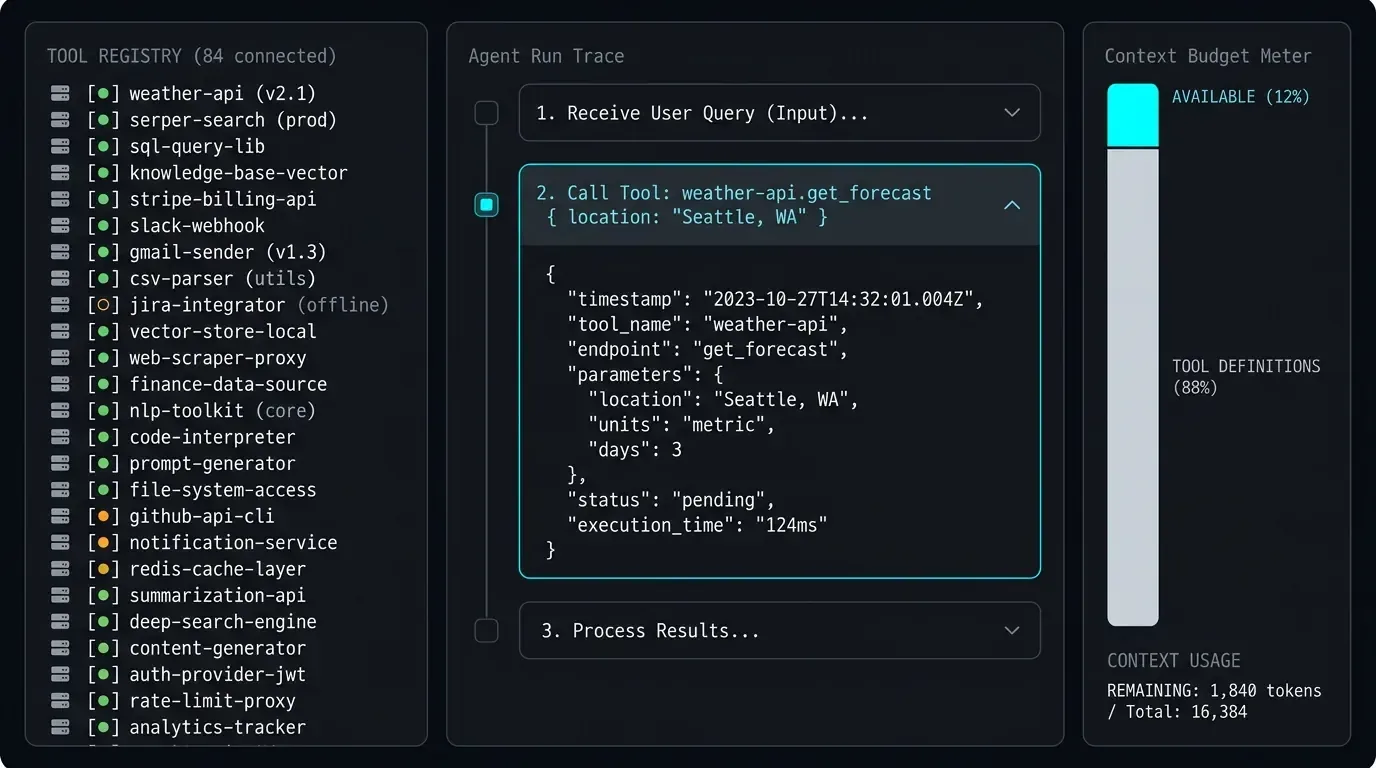
A dark agent console: a tool registry panel listing eighty-four connected tools, an agent run trace with one tool call expanded to its JSON payload, and a context budget meter showing tool definitions holding eighty-eight percent of the window with twelve percent left
On this sheet

Two years ago, connecting a language model to your CRM was a quarter of the project plan. Today a competent engineer does it before lunch.

Integration friction was doing a second job nobody budgeted for. It forced somebody to justify a connection before the company paid for it. At three weeks, a manager asked what the tool was for. At twenty minutes, nobody asks.

The gate is gone and nothing replaced it.

Three costs land after that, and all three land on the executive rather than the engineer.

Three costs, one cause

Where each one lands

Cost What it shows up as Who owns it
Context budget Vaguer answers, higher bills, tools chosen wrong Whoever signs off the model spend
Three-party security An action taken on your behalf that nobody authorized Whoever signs the GDPR processing record
The unasked question An agent doing a job a script does better Whoever defends the budget next year

None is a protocol flaw. They are what happens when a decision gate disappears and nothing takes its place.

The tool menu charges rent

Every tool an agent can reach has to be described to it, and that description loads before the model reads a word of your request. Thirty servers added over a year, twenty minutes each, and the menu now arrives before the meal every single time.

A workflow that consumed roughly 150,000 tokens passing tool definitions and intermediate results through the model was rebuilt to use about 2,000, a reduction of 98.7 percent.

— Anthropic, Code execution with MCP, November 2025

Do not take 98.7 percent as your number. Take the shape of it and run your own: tokens loaded before the request, times volume, times your rate card. Most teams have never done that multiplication.

A useful scale, from Sebastian Wallkötter’s February 2026 interview with KDnuggets: a 200,000-token window is roughly a full-length novel. It turns something most people treat as unlimited into a budget with edges.

Those edges have competing claims, and the claims are not equal.

Claims on the window

Claim on the window Verdict
Tool definitions, loaded up front Yes, load them on demand
Intermediate results round-tripping through the model Yes, keep them in the execution environment
Retrieved documents Partly, through better retrieval
Your operating context: rules, formats, what good looks like here No, and this is the part you are paying for

The bottom row is the point.

Orchestration and tool catalogs are things you can buy. Context is not, and the tool menu evicts it.

We made that case at length in the piece on buying the platform but not the context.

Your controls assume two parties. There are three.

Who is in the transaction

Party Claims Controls check
The person The employee who asked Usually, yes
The model provider Acting on that person’s behalf Rarely, and not per action
The service reached Honoring a token it was handed Only that the token is valid

The middle row is the one that shows up in a processing record.

If an agent moved personal data, the document has to say on whose instruction, and “the assistant decided to” does not survive a review.

The standard has moved. The first revision, November 2024, shipped with no authorization framework at all. OAuth 2.1 arrived in March 2025, and the June 2025 revision made the server a proper resource server.

Deployments have not.

Of 7,973 live remote MCP servers identified, 40.55 percent exposed tools with no authentication mechanism at all. Of 119 OAuth-enabled servers tested dynamically, every one carried at least one flaw, 325 in total, leading to nine CVE identifiers.

— A First Measurement Study on Authentication Security in Real-World Remote MCP Servers, arXiv:2605.22333 · May 2026

Authentication is the tractable half. The other is prompt injection, where content a tool returns carries instructions the model then follows. The usual hope is a fix like the one that closed SQL injection: separate the instruction from the data.

SQL injection was solvable because query structure and user data are separable in principle. In a language model they are the same substance.

Two years in, every mitigation is probabilistic. We would drop that view the week somebody proves otherwise.

The practical consequence is narrow. Every tool an agent can reach is available to anyone who can write into that agent’s context. Tool count is blast radius.

The cheapest fix is often not AI

Wallkötter spent his doctorate on human-robot interaction and describes humanoid robots as “a bit like an unstable equilibrium.” Impressive in a demonstration, hard to justify once somebody asks what job it does. Take the legs off, put wheels on, and you get something cheaper and sturdier that nobody films.

The software version he ran into: a sophisticated coding system with an agent whose job was identifying unreliable tests. Run the test ten times. If it passes sometimes and fails sometimes, it is unreliable. That is what the word means.

The deterministic version is instant, free, right every time, and needs no security review. The agent version costs tokens, is occasionally wrong, and adds another line to a crowded menu.

Models earn their cost on judgment under ambiguity. They lose to a script wherever the answer has a definition you can write down.

Four questions separate the cases:

Ask them in this order

Test Question Answer
The rule Can a rule you can write down check the output? Write the rule.
The repeat Must the same input give the same answer every time? Wrong instrument.
The blast Would a wrong answer be costly and hard to notice? Script, or a model with a human checkpoint on the action.
The judgment Is the input unstructured language and the judgment genuinely fuzzy? That is what the model is for.

Most agent work we are asked to review fails the first question, and fails it untested, because the plain version was never built.

Narrow agents and a written tool budget

In our engagements, one agent with forty tools has consistently lost to four agents with six each. The component that picks which path a request takes can only choose well between options it can tell apart. Test that on your own traffic before committing to it.

The control that makes it stick is duller than the architecture. Every agent gets a written tool list, with an owner and a reason against each entry. Adding one means removing one or making the case.

This week Do this week: list the tools your agents can currently reach, put a name and a reason beside each, and count the ones nobody can defend. That takes an hour, and the number you cannot defend is usually the diagnosis.

The objection The objection is that load-on-demand already fixes this. It fixes one cost of three. A tool loaded only when needed still exists, still needs maintaining, and is still reachable.

The token bill was always the least interesting of the three.

Write down the dumb version first

Everything above assumes the agent should exist. The only honest moment to test that is now, while nobody has anything to defend yet.

Write three things down before the connection is made:

The floor A quality floor, with a date against it.

The ceiling A cost ceiling per run, once volume is real.

The baseline The deterministic baseline: the plainest non-AI version of the task, and how well it actually performs.

The third does most of the work. If nobody can describe the script version, the team does not understand the task well enough to automate it. If the script exists and the agent cannot beat it by a margin worth the operating cost and the added attack surface, the answer arrives in a day instead of a quarter.

This is the Bearing phase of our AZIMUTH method, set out on the Method page. Clients argue with it right up until the quarter it stops a project before the project stops itself.

The protocol removed a cost. It never removed the decision underneath it.

Last reviewed August 2026. Corrections are logged, not made silently. What would change our position: a prompt injection mitigation that holds under adversarial testing rather than on average.

Start

Reading about it is the slow way.

Open an account and run one module on one brand, or book a demo and see the platform on your own data.

No subscription. No seat fee. No card required to request an account.