


Is the AI gap between small and large European firms a matter of size, or of choices a small firm can make? Eurostat’s 2025 survey of EU enterprises says more about that than its headline does. Every figure below comes from that one survey, so “use” means the same thing throughout: at least one of eight AI technologies, from text mining to image generation.
17% against 55.03%, and the gap is widening
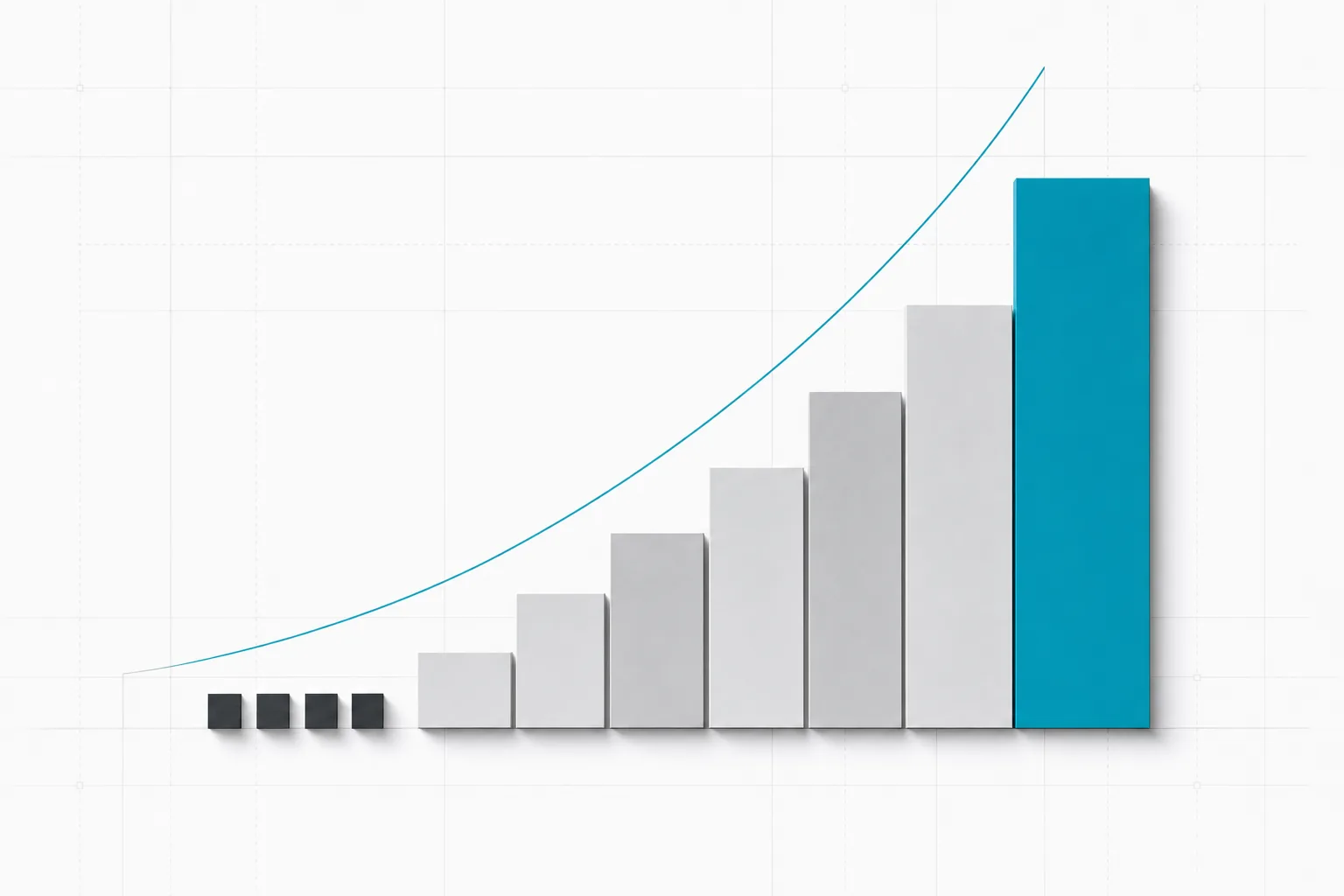
In 2025, 17% of small EU enterprises used AI, against 30.36% of medium ones and 55.03% of large ones. Eurostat counts firms with 10 to 49 staff as small. Firms under ten aren’t surveyed.
Small firms grew faster in relative terms. Eurostat’s database puts them at 11.21% in 2024, when large firms stood at 41.17%. Measured in points, though, the gap went from 29.96 to 38.03 in a year.
Depth tells the same story. Only 10.57% of small firms use two or more AI technologies. Among large firms it’s 43.97%.
Most small firms never weighed it
Among EU firms that didn’t use AI in 2025, only 12.65% of small ones had ever considered it. For large firms the figure was 36.54%.
So the typical small non-user didn’t try AI and give up. It never looked. Eurostat suggests three possible reasons for the size gap: AI is complex to put in place, larger firms gain more from scale, and the investment is easier for them to carry. The answers of firms that did look point mostly to the first.
Expertise comes first, cost fourth
Small firms that considered AI and didn’t adopt it gave these reasons, with the share for large firms alongside:
- Missing expertise: 70.87%, against 65.11%.
- Unclear legal consequences: 54.79%, against 51.22%.
- Data protection concerns: 52.49%. Large firms worry more, at 58.76%.
- Cost: 38.82%, against 34.78%.
- “Not useful for us”: 19.22%, close to twice the 9.77% of large firms.
Small firms that held back mostly didn’t know how, weren’t sure of the rules, or didn’t see what AI would do for them. Price came well after.
Marketing is where the gap is smallest
Among firms already using AI, 34.06% of small ones put it to work in marketing or sales. For large ones it’s 37.89%. The widest gap is in IT security, at 14.51% against 47.51%. Small adopters aren’t far behind on the work that brings in customers.
Size isn’t destiny
Country matters too. In 2025, 37.45% of small firms in Denmark used AI, along with 33.51% in Finland and 30.74% in Sweden. Large firms in Romania were at 20.75%, and in Bulgaria at 26.18%. The survey doesn’t say why. It does show that headcount alone doesn’t settle the question.
What an owner can do this quarter
- Ask the question once, on purpose. Pick one job a 250-person competitor probably runs with AI, like answering quote requests or drafting product pages, and decide whether to test it.
- Buy expertise before software. Name one person to learn the tools, and give them the hours.
- Write two short rules. What data may go into an AI tool, and which legal duties apply where you sell.
- Start in marketing and sales. That’s where small adopters are closest to large ones.
For figures from the US and Singapore too, see our five numbers every SME owner should know about AI.
Eurostat plans its 2026 edition for December 2026, and we’ll update this page when it’s out. A note on sources: Eurostat’s article prints the 2024 reasons for not using AI, so the 2025 reasons above are taken from its database. Corrections to hello@bearingbridge.com.