
Skip to content

Intelligence Layer

One account, one ledger, one agent layer. The modules are what you switch on.

Platform overview
The AI Intelligence Layer

One intelligence layer under every module: the same data, the same agents, the same ledger, whichever function you switch on.

  • One layer, every module
  • Shared data and agents
  • Every run on one ledger
Go to The AI Intelligence Layer
Isometric stack of pale grey slabs wired together on white, with one layer filled deep cyanStart hereThe architecture is the argumentWhy adding the sixth module costs a fraction of buying the first.Read the architecture
The Architecture

One account carries every brand you run. Modules are switched on per brand, and every run lands in the same ledger.

  • One account, many brands
  • Modules toggle per brand
  • A single billing ledger
Go to The Architecture
Isometric stack of pale grey slabs wired together on white, with one layer filled deep cyanStart hereThe architecture is the argumentWhy adding the sixth module costs a fraction of buying the first.Read the architecture
The agent layer

Three kinds of agent. Watchers notice, drafters produce, and Ask Intelligence answers from your own numbers.

  • Watchers run on a schedule
  • Drafters wait for sign-off
  • Answers carry their source
Go to The agent layer
Isometric stack of pale grey slabs wired together on white, with one layer filled deep cyanStart hereThe architecture is the argumentWhy adding the sixth module costs a fraction of buying the first.Read the architecture
Security

Isolated tenancy, roles that mean something, and a plain answer about what leaves your account.

  • Per-tenant isolation
  • Roles down to the module
  • Stated data boundaries
Go to Security
Isometric stack of pale grey slabs wired together on white, with one layer filled deep cyanStart hereThe architecture is the argumentWhy adding the sixth module costs a fraction of buying the first.Read the architecture

Seats are free — you pay for what the AI runs

Book a demoOpen your account

Capabilities

The AI you work with directly, and the modules it already runs. Take one, or take them all.

See all modules

AI Assistance

Work with the AI directly

Ask Intelligence

Ask a business question in plain words. It reads your own data through read-only tools scoped to the brand, and answers with the real figure or says the data is not there.

  • Fifteen read-only tools
  • Scope enforced in code
  • Never invents a number
Go to Ask Intelligence
Playground

A direct chat with the models your administrator allows. No brand data: the model sees the conversation, your files and your instructions.

  • Compare three models side by side
  • Files in, documents out
  • The price under every answer
Go to Playground
Agents

Three kinds of agent do the standing work: watchers notice, drafters produce, and nothing ships until someone with the role signs.

  • Watchers run on a schedule
  • Drafters wait for sign-off
  • Every run lands on the ledger
Go to Agents
Skills

How a brief is built, how a campaign is structured, what a decent article looks like — the craft of the people who built this, shipped as the default setting.

  • Senior practice built in
  • Defaults you adjust
  • Nothing to write from scratch
Go to Skills

Modules & Features

The functions it runs

Business Intelligence

Ask your business a question in plain words and get the real number back, with the source that produced it.

  • Plain-language questions
  • Every figure sourced
  • Board-ready reporting
Go to Business Intelligence
Project Management

The board where an insight becomes a card with an owner, instead of a dead report nobody actions.

  • Kanban with a timeline
  • One click, insight to task
  • Owner and date attached
Go to Project Management
Sales

Pipeline that drafts its own paperwork, and flags the deals that went quiet before you notice.

  • Quotes off the deal record
  • Quiet deals surfaced
  • Revenue projected forward
Go to Sales
Brand Marketing

The content engine and the Creative Studio behind the brand: articles buyers actually search for, and the images and video that carry them.

  • Eight-stage content engine
  • Creative Studio built in
  • Drafts wait for sign-off
Go to Brand Marketing
Social

Posts drafted from work you have already approved — an article becomes the thread, a launch becomes the post — on a calendar you sign.

  • Drafts from approved work
  • A calendar you sign
  • One voice on every network
Go to Social
Search

Watches where you rank, ties every position to the page that earned it, and says what to write next — with GEO watching the AI assistants.

  • Rank tracked continuously
  • Positions tied to pages
  • GEO polls the assistants
Go to Search
Ads

Search campaigns arrive built — ad groups, keywords, copy — priced before they run, and paused the moment they stop earning.

  • Campaigns priced first
  • Ad groups arrive built
  • Paused when they slip
Go to Ads
Customer Service

Answers from what you gave it, on your own page, and it says so plainly when it does not know.

  • Grounded in your content
  • Refuses to invent
  • Escalates to a human
Go to Customer Service
IT Support

The support desk turned inward: employees ask, it answers from your own systems and documentation, and escalates what it cannot resolve.

  • Answers from your docs
  • Tickets triaged first
  • Escalates to a human
Go to IT Support

Seats are free — you pay for what the AI runs

Book a demoOpen your account

Services

The people around the product, from the first connection to a named operator on your account.

All services
Onboarding

A guided session to connect your data and switch on the first function, then a first week planned day by day.

  • One guided session
  • First function live in a week
  • A person on the other end
Go to Onboarding
A fanned stack of white ruled sheets with the top one edged in deep cyanLarger organizationsRoll out by brand, by team, by functionOne account, one ledger, roles down to the function. Staged so procurement never has to open a file.See the group rollout
Data integration

We connect the systems you already run and prepare the data behind them, so every answer has a source.

  • Connectors built and tested
  • Metrics defined once
  • Sources reconciled
Go to Data integration
A fanned stack of white ruled sheets with the top one edged in deep cyanLarger organizationsRoll out by brand, by team, by functionOne account, one ledger, roles down to the function. Staged so procurement never has to open a file.See the group rollout
Intelligence audit

A fixed-price review of where you rank, what the AI assistants answer, and which function pays back first.

  • Four assistants polled
  • Search position by market
  • A ranked starting point
Go to Intelligence audit
A fanned stack of white ruled sheets with the top one edged in deep cyanLarger organizationsRoll out by brand, by team, by functionOne account, one ledger, roles down to the function. Staged so procurement never has to open a file.See the group rollout
Training

Sessions for the people who will approve, review and ask, so the workforce is used rather than watched.

  • By role, not by feature
  • Live on your account
  • Recorded for the next hire
Go to Training
A fanned stack of white ruled sheets with the top one edged in deep cyanLarger organizationsRoll out by brand, by team, by functionOne account, one ledger, roles down to the function. Staged so procurement never has to open a file.See the group rollout
Managed operations

Someone reviews what the watchers found, approves the drafts within your caps, and runs the weekly review.

  • Drafts approved in your name
  • Caps respected
  • Weekly review delivered
Go to Managed operations
A fanned stack of white ruled sheets with the top one edged in deep cyanLarger organizationsRoll out by brand, by team, by functionOne account, one ledger, roles down to the function. Staged so procurement never has to open a file.See the group rollout
Custom features

An agent or a function built for your process, on the same ledger and under the same approval gates.

  • Scoped before it is priced
  • Same gates, same ledger
  • Yours to keep
Go to Custom features
A fanned stack of white ruled sheets with the top one edged in deep cyanLarger organizationsRoll out by brand, by team, by functionOne account, one ledger, roles down to the function. Staged so procurement never has to open a file.See the group rollout
Dedicated hosting

A single-tenant deployment in the region you choose, with the data boundary written down and an uptime commitment.

  • Single tenant
  • Region of your choice
  • Uptime in writing
Go to Dedicated hosting
A fanned stack of white ruled sheets with the top one edged in deep cyanLarger organizationsRoll out by brand, by team, by functionOne account, one ledger, roles down to the function. Staged so procurement never has to open a file.See the group rollout
Premium Support

A named contact, committed response times, and a quarterly review of what ran, what it cost and what to change.

  • Named contact
  • Committed response times
  • Quarterly review
Go to Premium Support
A fanned stack of white ruled sheets with the top one edged in deep cyanLarger organizationsRoll out by brand, by team, by functionOne account, one ledger, roles down to the function. Staged so procurement never has to open a file.See the group rollout

Seats are free — you pay for what the AI runs

Book a demoOpen your account

About

Why this was built, who is behind it, what it has done for the companies running it, and how to run it well.

About BearingBridge
Why we built it?

What a company can do has been capped by who it could afford to hire. That cap is the thing that moved.

  • Capability, not headcount
  • Written, not benchmarked
  • No lock-in claim
Go to Why we built it?
A row of pale grey blocks climbing steeply to a single tall deep cyan block, a hairline curve tracing the riseThe short versionPunch above your headcountThe AI workforce for companies that need more capability than they can staff.Read the argument
Who is behind BearingBridge?

Who built this, what it is independent of, and why that independence is worth stating out loud.

  • Model-independent
  • No data resale
  • Named people behind it
Go to Who is behind BearingBridge?
A row of pale grey blocks climbing steeply to a single tall deep cyan block, a hairline curve tracing the riseThe short versionPunch above your headcountThe AI workforce for companies that need more capability than they can staff.Read the argument
How we run the work

The six-phase method every account is built on: a written bearing, a dated baseline, a pilot on real data, and a fix that reconciles the money.

  • A kill criterion, in writing
  • Costs watched as they run
  • An ending without us
Go to How we run the work
A row of pale grey blocks climbing steeply to a single tall deep cyan block, a hairline curve tracing the riseThe short versionPunch above your headcountThe AI workforce for companies that need more capability than they can staff.Read the argument
Case studies

Ten builds told the way they ran: the situation, what was built, what changed months later, and what got switched off.

  • Sector and function stated
  • Client-verified figures
  • The stopped work left in
Go to Case studies
A row of pale grey blocks climbing steeply to a single tall deep cyan block, a hairline curve tracing the riseThe short versionPunch above your headcountThe AI workforce for companies that need more capability than they can staff.Read the argument
FAQ

The questions that come up before every demo, answered here so the demo can be about your business.

  • Product and billing
  • Security and data
  • Answered in plain words
Go to FAQ
A row of pale grey blocks climbing steeply to a single tall deep cyan block, a hairline curve tracing the riseThe short versionPunch above your headcountThe AI workforce for companies that need more capability than they can staff.Read the argument
Testimonials

Customers on the module they actually run, quoted directly, with the module named.

  • Module named each time
  • Quoted, not paraphrased
  • Role and size given
Go to Testimonials
A row of pale grey blocks climbing steeply to a single tall deep cyan block, a hairline curve tracing the riseThe short versionPunch above your headcountThe AI workforce for companies that need more capability than they can staff.Read the argument
Changelog

What shipped, dated, newest first. The place to check whether the thing you were promised exists yet.

  • Dated entries
  • Shipped only
  • Linked to the module
Go to Changelog
A row of pale grey blocks climbing steeply to a single tall deep cyan block, a hairline curve tracing the riseThe short versionPunch above your headcountThe AI workforce for companies that need more capability than they can staff.Read the argument
Partner program

Run the platform for the companies you advise. Every client is a brand on your account, billed on its own ledger.

  • Clients as brands
  • Separate ledgers
  • Margin on every run
Go to Partner program
A row of pale grey blocks climbing steeply to a single tall deep cyan block, a hairline curve tracing the riseThe short versionPunch above your headcountThe AI workforce for companies that need more capability than they can staff.Read the argument

Seats are free — you pay for what the AI runs

Book a demoOpen your account

Pricing

Seats are free. You pay for what the AI actually runs, and you see the price first.

Full pricing
How it works

Three sentences, and that is the whole model. No tiers to decode, no per-seat arithmetic to do.

  • No seat licence
  • No annual lock-in
  • Three sentences long
Go to How it works
Ten pale meter tracks filled to different levels in deep cyan, cut by one horizontal cyan limit lineNo surprisesYou see the price before you run itThe price, the caps and the gates, all visible before anything spends.Open pricing
Seats

Give an account to everyone who needs one. The number on the invoice does not move when you do.

  • Unlimited accounts
  • Zero per-seat cost
  • Roles still enforced
Go to Seats
Ten pale meter tracks filled to different levels in deep cyan, cut by one horizontal cyan limit lineNo surprisesYou see the price before you run itThe price, the caps and the gates, all visible before anything spends.Open pricing
What things cost

Every run is priced from your wallet before or as it runs, and the machine’s own mistakes are not billed to you.

  • Quoted before it runs
  • Retries are on us
  • Itemised in the ledger
Go to What things cost
Ten pale meter tracks filled to different levels in deep cyan, cut by one horizontal cyan limit lineNo surprisesYou see the price before you run itThe price, the caps and the gates, all visible before anything spends.Open pricing
Caps and gates

A hard cap per module, and an approval gate in front of anything that publishes or spends.

  • Hard cap per module
  • Approval before publish
  • A zero balance stops the AI
Go to Caps and gates
Ten pale meter tracks filled to different levels in deep cyan, cut by one horizontal cyan limit lineNo surprisesYou see the price before you run itThe price, the caps and the gates, all visible before anything spends.Open pricing
Questions

The questions people actually ask about the bill, answered on the page rather than in a call.

  • Overage answered
  • Cancellation answered
  • Migration answered
Go to Questions
Ten pale meter tracks filled to different levels in deep cyan, cut by one horizontal cyan limit lineNo surprisesYou see the price before you run itThe price, the caps and the gates, all visible before anything spends.Open pricing

Seats are free — you pay for what the AI runs

Book a demoOpen your account

Insights

Three collections, one standard: long-form, sourced, dated, and never behind a form.

All insights
AI Trends

What is moving under the industry: model economics, the Chinese price tier, and how buyers now ask assistants instead of searching.

  • The model market, read closely
  • AI search and citations
  • Every claim sourced and dated
Go to AI Trends
A fanned stack of white ruled sheets with the top one edged in deep cyanThe standardLong-form, sourced, never gatedEach piece answers the question in its title completely, carries its date, and sits behind no form.Open the library
Best Practices — AI Guide

The working guide: when to buy and when to build, when an agent is the wrong tool, and what survives contact with production.

  • Build-or-buy, decided
  • Architectures that ship
  • Prompts that do real work
Go to Best Practices — AI Guide
A fanned stack of white ruled sheets with the top one edged in deep cyanThe standardLong-form, sourced, never gatedEach piece answers the question in its title completely, carries its date, and sits behind no form.Open the library
CEO's Opinion

Signed columns from the person running the company: what building agents across six functions actually shows, ahead of the industry line.

  • Signed, never ghostwritten
  • From live builds, not decks
  • Positions, not press releases
Go to CEO's Opinion
A fanned stack of white ruled sheets with the top one edged in deep cyanThe standardLong-form, sourced, never gatedEach piece answers the question in its title completely, carries its date, and sits behind no form.Open the library

Seats are free — you pay for what the AI runs

Book a demoOpen your account

Insights/AI Trends/AI visibility & search

Your buyers decide before the click.

Organic sessions are falling. The traffic replacing them converts better than almost anything else you run. Those two facts belong on the same board slide, and usually are not. Every figure below is dated, and this page is reviewed on the first of each month.

42%

better conversion from AI traffic, US retail, March 2026

393%

year-over-year growth in AI referred traffic, Q1 2026

94%

of buying groups rank their vendors before first contact

BearingBridgeJuly 202610 min read

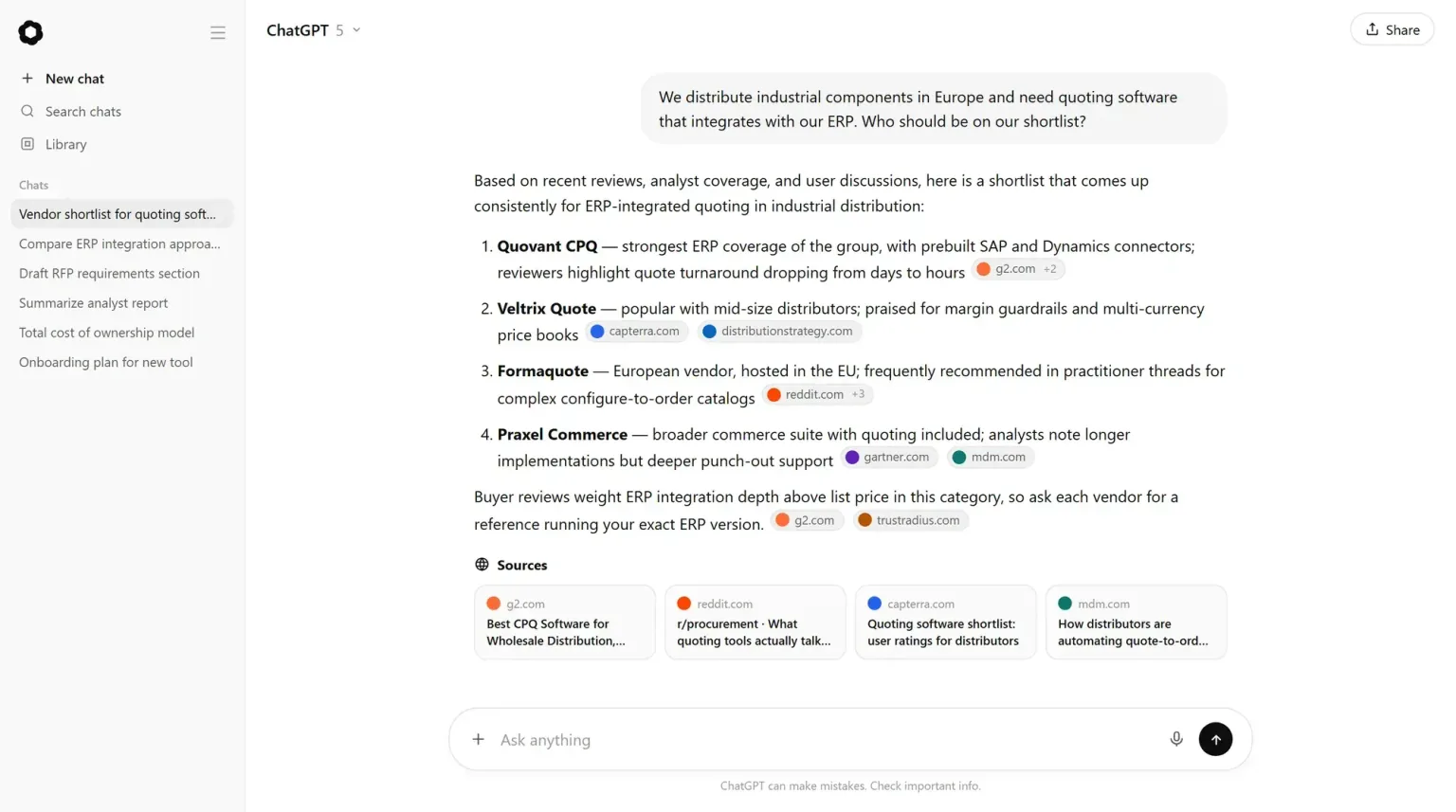
A ChatGPT answer to a B2B buying question: a ranked shortlist of quoting software vendors, each line carrying citation chips from review sites and communities, with a row of source cards underneath
On this sheet

Twelve months ago, the AI referral line in a retail analytics stack was the worst performing thing in it. Shoppers who arrived from an assistant bought less often than shoppers from paid search, email, or affiliates. Today the same line is the best performing thing in it.

In March 2026, traffic from AI sources to US retail sites converted 42% better than non-AI traffic, a record high. In March 2025, that same traffic converted 38% worse.

— Adobe Analytics, 2026 Q2 AI Traffic Report, April 16, 2026 · drawn from more than one trillion visits to US retail sites

The same line, twelve months apart

Period Result
March 2025 38% worse
March 2026 42% better

Conversion of AI-referred traffic against non-AI traffic, US retail. The two figures are measured against different baselines; the direction is the finding.

Those two figures are measured against different baselines, so the tidy “eighty point swing” being quoted around this report is looser than it sounds. The direction is not loose at all. In twelve months a channel went from the worst performer in US retail to the best of them, and the volume came with it. AI referred traffic grew 393% year over year in the first quarter of 2026, and those visitors stayed 48% longer and generated 37% more revenue per visit than everybody else.

Retail is where this shows up first, because retail transacts fast enough to measure inside a quarter. Nobody publishes a comparable dataset for a nine-month enterprise sale. The behavior underneath it is the same behavior, and in a considered purchase it is harder to see and costlier to miss. McKinsey puts $750 billion of US revenue flowing through AI powered search by 2028, which is a projection rather than a measurement, but the projections and the measurements are now pointing the same way.

Put any of it next to your own organic sessions chart and the strategic question changes shape. The question is no longer how to win the clicks back. It is which of your numbers still measures demand, and most executives have not been given a straight answer to that one.

What moved, and what it costs you to ignore it

What you used to manage What decides the outcome now
Rank on a results page Presence inside an answer you cannot see
Sessions as the demand signal Conversion and revenue per visit, split by source
Your website as the pitch A source base you mostly do not own
SEO as one owned function Two budgets, two owners, two clocks
An annual channel review A monthly baseline, because platforms change without notice

None of those rows is a marketing tactic. They are management changes, which is why they tend to get delegated one or two levels below where they belong.

Most of your readers are now machines

Cloudflare sits in front of about a fifth of the web and counts what reaches it. In June its own measurement crossed a line its chief executive had publicly forecast for late 2027.

Automated requests passed human ones for the first time, at roughly 57% of HTML requests to web content against 43% from people.

— Cloudflare Radar, figure shared by CEO Matthew Prince, June 3, 2026 · network sitting in front of about a fifth of the web

Who is actually reading the web

Share
Machines 57%
People 43%

Share of HTML requests to web content, Cloudflare network, June 2026.

Machines reading your content is not new. What changed is the terms. For two decades the arrangement was reciprocal enough: a crawler took your page and an engine sent you a reader in exchange.

Crawl to referral ratios for leading AI bots have been observed anywhere from 118:1 to nearly 50,000:1, against the roughly balanced ratios of traditional search crawlers.

— Cloudflare, Attribution Business Insights, July 2026 · ratios observed across leading AI crawlers

Pages crawled per visitor sent back

Crawler type Ratio Note
Traditional search crawlers ≈ 1 : 1 roughly balanced
Leading AI bots, low end 118 : 1 observed
Leading AI bots, high end ≈ 50,000 : 1 training crawlers, no referral mechanism

The spread is wide because it covers different bots in different months, and the worst offenders are training crawlers with no referral mechanism at all. Treat it as a direction rather than a precise figure. If you are a publisher this is your revenue model coming apart. If you are a brand it is something less dramatic and nearly as awkward: your content is now being read mostly by something that will not visit, will not convert, and will not appear in any report you currently run. Crawl activity and traffic have come apart. Any dashboard still reading the first as a leading indicator of the second is describing a relationship that stopped holding.

There is also the question of what those machines find when they arrive.

Across the US retail sector, average AI visibility scores came in at 75% for homepages, 74% for category pages, and 66% for individual product pages. A score of 50% means half the content on the page cannot be read by a model.

— Adobe, AI Content Visibility Checker benchmark, April 16, 2026 · pages sampled across the US retail sector

How much of each page a model can read

Page type AI visibility score
Homepages 75%
Category pages 74%
Product pages 66%

The page carrying price, availability and specification is the least readable one in the estate.

So the product page, the one carrying price and availability and specification, is the least readable page in the estate. That is precisely the page a shopping assistant is trying to read. We see the same shape in non-retail audits: the marketing pages score fine and the pages holding the actual facts score badly, because those were built for a rendering engine rather than a reader. It is a supply problem, and a bigger content calendar does not touch it.

The shortlist closes before you know it opened

Which brings the argument to the part that applies whether or not you sell anything online. If you sell a considered purchase rather than a pair of running shoes, the number that should hold your attention is not any of the ones above. It comes from the B2B side, and it predates the AI search argument entirely.

94% of buying groups ranked their preferred vendors before first contact with a seller, and bought from that preliminary favorite 77% of the time. The balance between independent research and seller engagement moved from 70/30 to 60/40.

— 6sense, 2025 Buyer Experience Report, November 12, 2025 · more than 4,000 buyers across North America, EMEA, and APAC

  • 94% of buying groups rank their preferred vendors before first contact
  • 77% of the time, the preliminary favorite wins the deal

Independent research vs seller engagement

When Independent research Seller engagement
Before 70% 30%
Now 60% 40%

Sixty percent of the journey happens before anyone at your company knows the deal exists.

Sixty percent of the journey happens before anyone at your company knows the deal exists. More of that sixty percent every quarter runs through an assistant that reads the reviews, lines the vendors up and hands over a shortlist. Miss that answer and you are missing from a ranking that already calls the winner better than three times in four.

Sales cannot recover this later, for the simple reason that sales has not been invited yet. The same research found something worth reading twice by anyone selling an AI enabled product: 89% of purchases included AI features, and 58% of buyers reached out to sellers early specifically because vendors had not explained those features clearly enough anywhere a buyer could find them.

That is a content gap with a revenue number attached, and one of the few in this piece you can close without anyone else’s cooperation.

AEO and GEO are two budgets, not two words

None of that is fixed by renaming the SEO budget, which is roughly what the industry has done. Two labels have stuck. They are useful, but only if you read them as separate spend categories.

Answer engine optimization is work on property you own: structuring pages so a machine can lift a clean answer out of them, and making sure product data resolves without a browser. It is engineering, it is mostly a fixed cost with maintenance after it, and it sits inside your control.

Generative engine optimization is work on property you do not own. It is earning a place in the source base a model reads before it answers. The reason these cannot share a line item sits in one ratio.

A brand’s own sites make up only 5 to 10 percent of the sources AI search references. In categories such as consumer packaged goods and financial services, more than 65 percent of sources are publishers, user generated content, and affiliate sites.

— McKinsey, New front door to the internet, October 16, 2025 · source-mix figures from Google AI Overview and McKinsey analysis

The sources behind the answer about you

  • Your own sites, 5 to 10 percent
  • Publishers, communities, review and affiliate sites, the remainder

On that estimate, nine tenths or so of what shapes the answer about you is written by somebody else. No amount of work on your own pages reaches it.

AEO and GEO compared line by line

AEO GEO
Optimizes Your pages, for extraction The wider source base, for inclusion
Work lands on Site, product data, schema Publishers, communities, review sites
Natural owner Web and product engineering Earned media and communications
Time to signal Weeks Two to three quarters
Cost shape Fixed build, then maintenance Recurring, closer to earned media
Failure looks like Cited but never named Never retrieved at all

You can hold the featured snippet and still be missing from a ChatGPT answer, which is why a single combined budget hides the failure of one half behind the success of the other. The mechanics underneath that difference, including why a citation and a mention are not the same event, are the subject of our earlier piece, How AI citations work, and why they matter.

The money moved. The capability did not.

Budget is not the constraint here. That makes this a harder internal conversation than most AI proposals, because you cannot fix it by asking for more.

CMOs allocate an average of 15.3% of marketing budgets to AI initiatives, and 70% say becoming an AI leader is critical for 2026. Only 30% report mature or fully developed AI readiness.

— Gartner, 2026 CMO Spend Survey, May 11, 2026 · 401 marketing leaders in North America, the UK, and Europe, mostly above $1B revenue

  • 15.3% of marketing budgets already allocated to AI initiatives
  • 70% say becoming an AI leader is critical for 2026
  • 30% report mature or fully developed AI readiness

The capability is arriving faster than the discipline around it.

Generative engine optimization is now in use at four in ten companies, a capability that did not appear in earlier editions of the survey.

— The CMO Survey, 35th edition, Duke University Fuqua School of Business with Deloitte and the American Marketing Association, fielded January 2026 · 308 US marketing leaders, 97% at VP level or above

Four in ten doing the work, three in ten ready to run it. Buy a capability faster than the organization can absorb it and you get spend without a control loop, which is the same pattern the last two years of AI pilots already ran through once. You can see where it shows up.

16% of brands systematically track how they perform in AI search.

— McKinsey, October 2025 · survey of Fortune 500 consumer brand CMOs, n ≈ 30

That last sample is about thirty people, so treat it as a signal and not a measurement. It stays on the page because it points the same direction as everything above it, and a weak sample shown as a weak sample beats a strong claim built on one.

Four decisions, in this order

The board number

Fix the number the board sees.

Sessions stopped being a demand metric the moment answers began arriving without clicks. Report conversion and revenue per visit by source, with AI referrals broken out from direct and organic. If your analytics still buckets assistant traffic as direct, that misattribution is costing you the argument before it starts.

The baseline

Take the baseline before you fund anything.

Run the questions your buyers actually ask, on the assistants they actually use, and record three outcomes: cited, named, neither. The build is not where the money goes. The money goes into re-running it on a fixed rhythm, and skip that and what you own is a screenshot rather than a baseline. Budget for it the way you budget a brand tracker, not a project. This is the Bearing phase of our AZIMUTH method doing unglamorous work.

Two owners

Split the budget and name two owners. AEO belongs with whoever owns the site and the product data. GEO belongs with whoever owns earned media. Give both to one person and you will get whichever half that person already knows how to do, delivered competently, while the other half simply does not happen.

The kill criterion

Write the kill criterion before the first invoice, not after the first disappointing quarter. Ours for this kind of engagement reads about like this: if a quarter of visibility work has not moved cited and named share on the prompts that matter, we stop, we put the reason in writing, and the budget goes somewhere with evidence behind it. Deciding the stop in advance is what separates a channel from a dashboard nobody is allowed to question.

Every figure above carries its date because most of them have a shelf life measured in months. Retrieval and citation behavior gets revised without announcement, and vendor reported data revises too. We check this piece on the first of the month and mark what changed. Corrections to hello@bearingbridge.com.

Start

Reading about it is the slow way.

Open an account and run one module on one brand, or book a demo and see the platform on your own data.

No subscription. No seat fee. No card required to request an account.