
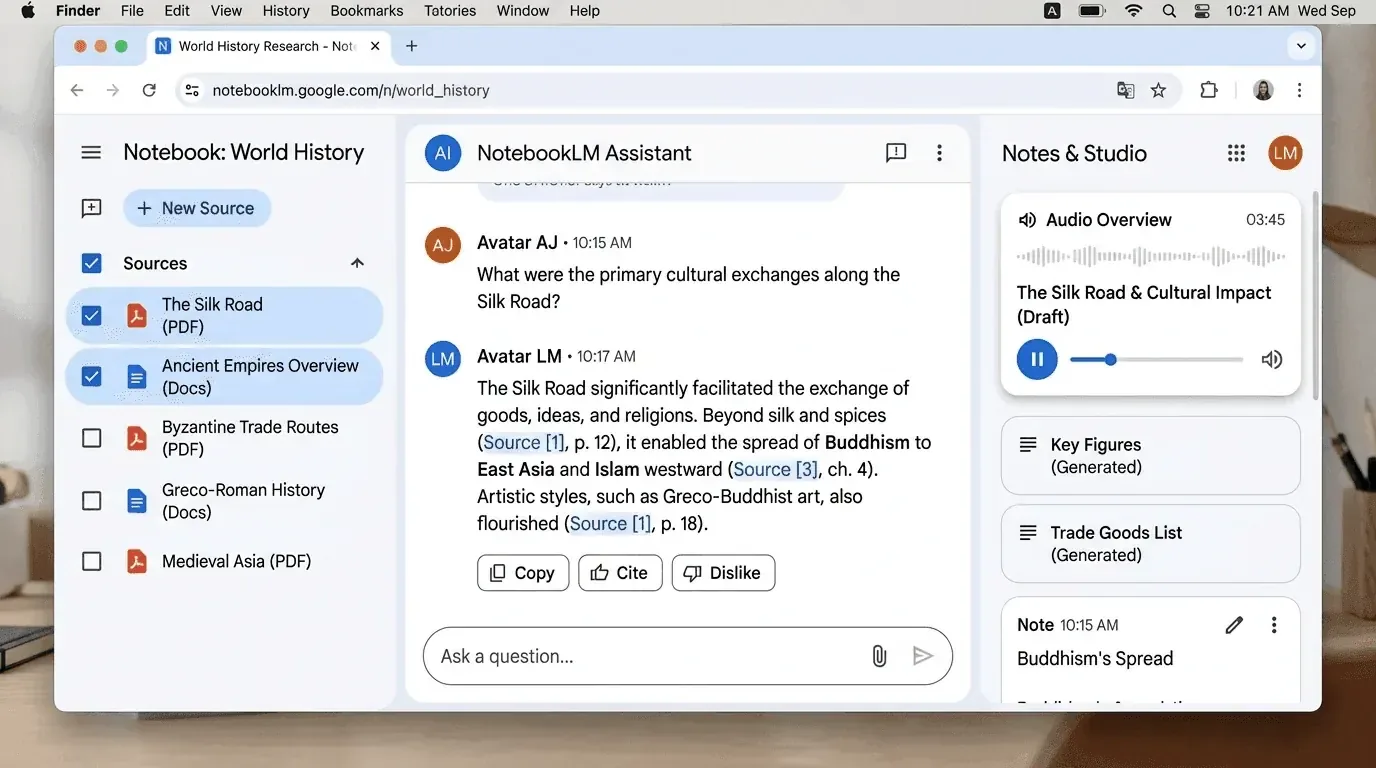
Google 的 NotebookLM 会通读您提供的文档,据此回答问题、生成摘要,甚至能把一摞文件变成一段音频对谈。学生和普通研究者的大部分需求,免费版就能满足;用量大的,可选 Google AI 订阅中捆绑的付费方案,每月 7.99 美元起。
据有关 Google 2026 年定价的报道,NotebookLM Plus 随每月 7.99 美元的 Google AI Plus 一并提供,各项额度约为免费版的两倍。
一次会话是有所收获还是过目即忘,差别通常不在文档,而在提示词。随口一问,得到的是一篇中规中矩的读后感;问得到位,它就会像导师、分析师,或一位毫不顾及您感受的编辑那样干活。以下十二条,是我们反复在用的。方括号里的内容是占位符,请自行填写。
锁定您正在学的语言
学外语的人大多见过这一幕:NotebookLM 开头用法语或日语答得好好的,一碰上难懂的概念,就悄悄退回英语。这条提示词能把它守在目标语言上。想用自己思考起来更顺手的语言啃下艰深材料时,它同样好用。
Build a back-and-forth discussion from the uploaded sources, spoken start to finish in [TARGET LANGUAGE]. Hold that language even through the hard parts. Reach for English only when a technical term has no clean equivalent, and say so when you do. Keep it loose, the way two people actually talk on a podcast.我们用得最多的场合是外文研究论文:教科书词汇和专家的实际行文之间,落差有时大到足以让人栽跟头。
直奔决策
设想早上九点打开一份四十页的报告,午饭前就得据此拿出行动。这条提示词就是为这种时刻准备的。它交回的不是摘要,而是会改变您做法的内容:人们实际卡在哪里,前面会遇到什么阻碍,文档又恰好略去了什么。
Read the uploaded files like you're prepping a brief for an executive who has ten minutes. Skip the warm-up. Give me three short lists. First, what real users are struggling with, with direct quotes. Second, what could block us, whether that's money, staffing, or technical limits. Third, what's missing that should worry us. If my goal isn't clear, stop and ask instead of guessing.最后那条指令,作用比看上去大得多。少了它,工具会兴冲冲地自选一个您根本没要的重点,一路写下去。
让它讲给初一学生听
检验是否真懂,有个老办法:讲给一个十二岁的孩子听,又不丢掉实质。这条提示词让 NotebookLM 过这一关,而暴露出来的漏洞,往往是您自己的。
Explain the uploaded material to a sharp twelve-year-old. Keep the sentences short and assume no background. For each piece, give a one-line plain version, a comparison to something from everyday life, and three difficult words spelled out simply. When a section gets thick, turn it into a quick true-or-false quiz.乍看像给孩子的学习窍门,这么想就小看它了。每次就一个主题动笔之前,我们都先用它检验自己是否真的吃透了。
复盘为何失手
有些尝试就是没打中靶心,坐着猜原因,往往白白耗掉一个下午。这时 NotebookLM 扮演一位直言不讳的评审:您把自己做的东西和本该依据的材料交给它,它指出两者在哪里分了岔。没有打气的客套,只有差距,原文逐句摆在您面前。
Something I tried didn't work and I want to know where it went wrong. Compare what I did against the uploaded sources. Here's the setup. What I tried: [WHAT]. The steps I took: [STEPS]. How it turned out: [RESULT]. What I expected instead: [EXPECTATION]. Show me the steps I skipped, the ideas I missed, and the basics I glossed over, citing the sources as you go. Keep it pointed at next time.先打个招呼:这一条可能有点扎心,因为它会从资料里摘出您没照做的那一句,和您的实际做法并排放着。让人难受,价值恰恰在此。
找出论证中的漏洞
读一篇自己本就有几分认同的文章时,它最派得上用场。与其一路点头,不如让薄弱环节逐一摊开;一份文档只是口气笃定,要想不被它带偏,这是最快的办法。
Go through the uploaded sources as a skeptical reader. List the main claims, then for each one tell me how well the source actually backs it up: strong evidence, thin evidence, or just asserted. Point out where the logic jumps a step, and flag any claim that would fall apart if one assumption turned out wrong.引用供应商白皮书或观点文章之前,我们都会先拿它过一遍。
让它出题,而不是给答案
学习者的心头好,把惯常的路数倒了过来:工具不再喂给您摘要,而是反过来考您,逼您主动回想所学,而不是第四遍重读,再把眼熟误当成记住。
Using only the uploaded material, write me a set of 15 questions that test whether I understand it, ordered easy to hard. Mix recall questions with ones that make me apply an idea to a new situation. Don't give the answers yet. Wait until I've tried, then grade me and explain what I missed.理出时间线
长文档把事情的先后顺序埋在段落里,读着读着就理不清头绪。这条提示词把顺序重新拎出来,让您看清前一件事如何引出后一件事。
From the uploaded sources, build a chronological timeline of the key events, decisions, or developments. Give each entry a date or rough time marker, a one-line description, and a note on why it mattered. Where the sources disagree on timing or details, say so rather than smoothing it over.适合案卷、项目沿革,以及任何因果纠缠不清的材料。
两份资料并排对比
上传了观点相左的几份报告,或同一主题的两种解读之后,有意思的不在任何单独一份,而在它们分道扬镳之处。
Compare [SOURCE A] and [SOURCE B] from the uploaded material. Lay out where they agree, where they directly contradict each other, and where one covers ground the other ignores entirely. For each disagreement, tell me what each side claims and what evidence they give. Don't pick a winner unless the evidence is genuinely one-sided.依据原始资料起草,不凭空编造
写作工具最爱编造。这条提示词把 NotebookLM 牢牢拴在您的真实材料上,交回的草稿出自您上传的内容,而非一切听着像回事的说法。
Using only the uploaded sources, draft a [BLOG POST / EMAIL / SUMMARY] of about [LENGTH] on [TOPIC]. Pull every fact and figure from the material, and mark anything you can't support from the sources so I can check it. Match a plain, direct tone. No filler openings.“mark anything you can’t support”(标出所有无法佐证的内容)这一句就是安全阀:它把猜测变成看得见、核得了的东西。
给计划做压力测试
计划写进文档、尚未拍板之前,不妨先听听反方的理由。这条提示词让 NotebookLM 用您自己的材料,替反方立论。
Treat the plan described in the uploaded sources as a proposal you've been asked to poke holes in. Give me the strongest case against it, drawn from the material itself: the risks, the costs, the assumptions that might not hold. Then tell me what would have to be true for the plan to work anyway.揪出待办事项
会议纪要和长串讨论,总把该办的事淹没其中。这条提示词把真正需要有人动手的事项,从周遭的讨论里剥离出来。
Read the uploaded notes and pull out everything that's actually an action item: something someone needs to do. For each one, give me the task, who owns it if the source says, and any deadline mentioned. Keep decisions and discussion separate from tasks. If an owner or date is missing, mark it as unassigned rather than guessing.换三种讲法
有些道理,第一种讲法未必讲得通。这条提示词从三个角度讲同一个概念,通常总有一个让您豁然开朗。
Take the hardest idea in the uploaded material and explain it to me three different ways: once with a plain definition, once with an analogy from everyday life, and once by walking through a concrete example step by step. Then tell me which of the three you think makes it clearest and why.写在最后
这些提示词都不复杂,而这恰恰是关键。工具有多好用,永远取决于问题问得多好。挑一条与手头任务对路的提示词,上传材料,换回来的就远不止一份摘要。这周拿手上正在做的事试一条,差别很快就能看出来。